
Chapter 43
E N D
Presentation Transcript
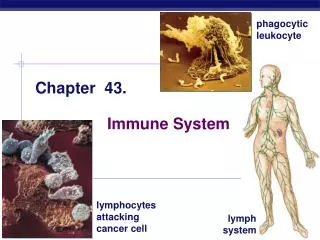
Chapter 43 Internal Defense
Immunology • Study of internal defensive responses • Immune response • Recognizing foreign or dangerous macromolecules • Responding to eliminate them
Nonspecific immune responses • Provide general and immediate protection • Pathogens • Some toxins and drugs • Cancer cells
Specific immune responses • Highly specific • Include immunological memory
Antigen • Molecule specifically recognized as foreign or dangerous by cells of the immune system • Antibodies • Highly specific proteins that recognize and bind to specific antigens
Invertebrate immune responses • Always nonspecific • Physical barriers • Cuticle • Skin • Mucous membranes
Phagocytosis • Antimicrobial peptides • Soluble molecules that destroy pathogens
Vertebrate nonspecific immune responses • First-line defenses • Physical barriers • Skin • Mucous linings of the respiratory and digestive tracts • Other nonspecific defenses
Soluble molecules important in immune responses • Antimicrobial peptides • Regulatory peptides • Proteins that destroy pathogens
Cytokines • Signaling proteins that regulate interactions between cells • Interferons • Inhibit viral replication and activate natural killer cells
Interleukins • Help regulate interactions between lymphocytes and other cells of the body • Some have widespread effects
Chemokines • Attract, activate, and direct the movement of certain cells of the immune system • Tumor necrosis factors (TNFs) • Kill tumor cells and stimulate immune cells to initiate an inflammatory response
Complement proteins • Enhance the inflammatory response • Lyse the cell wall of pathogens • Coat pathogens, enhancing phagocytosis • Attract white blood cells to the site of infection
Phagocytes destroy bacteria • Neutrophils • Macrophages • Natural killer cells (NK cells) • Destroy cells infected with viruses • Destroy foreign or altered cells such as tumor cells
Inflammatory response • Triggered when pathogens invade tissues • Vasodilation • Increased blood vessel diameter
Increased capillary permeability • Allows fluid and antibodies to leave the circulation and enter the tissues • Increased phagocytosis
In response to tissue injury, several types of molecules in the plasma that mediate inflammation are activated • Mast cells release histamine and other compounds that cause vasodilation and increased capillary permeability
Cell-mediated immunity • Specific T cells are activated • Proteins released that destroy cells infected with viruses or other intracellular pathogens
Antibody-mediated immunity • Specific B cells are activated • Multiply and differentiate into plasma cells, which produce antibodies
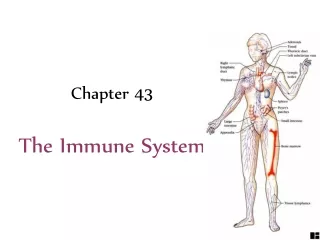
Immune system cells • Lymphocytes • Develop from stem cells in the bone marrow • T cells • B cells • Antigen-presenting cells (APCs)
T cells • Responsible for cell-mediated immunity • T cytotoxic cells (TC cells) • T helper cells (TH) • Memory T cells
Distinguished by T-cell receptors (TCRs) • Thymus gland confers immunocompetence on T cells by making them capable of distinguishing between self and non-self
B cells • Responsible for antibody-mediated immunity • Differentiate into plasma cells • Produce antibodies
Some activated B cells become memory B cells • Continue to produce antibodies after an infection has been overcome
Antigen-presenting cells (APCs) • Display foreign antigens as well as their own surface proteins • Macrophages • B cells
Dendritic cells • Located in tissues that interact with the environment • Specialized to process, transport, and present antigens
Major histocompatibility complex (MHC) • Immune responses depend on a group of genes that encode MHC proteins • Class I MHC genes • Encode self antigens, glycoproteins expressed on the surface of most nucleated cells
Class II MHC genes • Encode glycoproteins expressed on APCs of the immune system • Class III MHC genes • Encode components of the complement system and TNFs
Cell-mediated immunity process • Specific T cells are activated by a foreign antigen–MHC complex on the surface of an infected cell • A co-stimulatory signal and interleukins are also required • Activated TC cells multiply, giving rise to a clone
Clone cells migrate to the site of infection • Pathogen-infected cells destroyed • Activated TH cells give rise to a clone of TH cells • Clone cells secrete cytokines • B cells and macrophages activated
Antibody-mediated immunity process • B cells are activated when they combine with antigen • Activation requirements • APC (dendritic cell or macrophage) with a foreign antigen–MHC complex displayed on its surface • TH cell that secretes interleukins
Activated B cells multiply, giving rise to clones of cells • Cloned cells differentiate, forming plasma cells • Plasma cells produce specific antibodies, immunoglobulins (Ig), in response to the specific antigens that activated them
An antibody combines with a specific antigen to form an antigenantibody complex • May inactivate the pathogen • Stimulate phagocytosis • Activate the complement system
Antibody structure • Y-shaped • Two arms combine with antigen
Antigen- antibody complex
Antibody molecule • Four polypeptide chains • Two identical heavy chains • Two shorter light chains • Chain regions • Constant (C) region and • Variable (V) region
Recombination of DNA segments • Main factor responsible for antibody diversity • Occurs during the differentiation of B cells • Millions of different types of B (and T) cells are produced
Immunological memory • Memory B and memory T cells remain in the body after an infection • Responsible for long-term immunity
Primary immune response • Stimulated by the first exposure to an antigen • Secondary immune response • Stimulated by a second exposure to the same antigen • More rapid and more intense than the primary response
Active immunity • Develops as a result of exposure to antigens • May occur naturally after recovery from a disease • May be artificially induced by immunization with a vaccine
Passive immunity • Temporary condition • Develops when an individual receives antibodies produced by another person or animal
Response to cancer cells • NK cells, macrophages, and T cells recognize antigens on cancer cells and launch an immune response against them • Cancer cells evade the immune system by blocking TC directly or by decreasing their class I MHC molecules
Human immunodeficiency virus (HIV) • Retrovirus • Causes acquired immunodeficiency syndrome (AIDS) • Destroys T helper cells • Severely impairs immunity
Graft rejection • Transplanted tissues have MHC antigens • Immune response stimulated • T cells destroy the transplant