
Comprehensive Analysis of Major Cations and Anions in Water Samples Using Advanced Techniques
E N D
Presentation Transcript
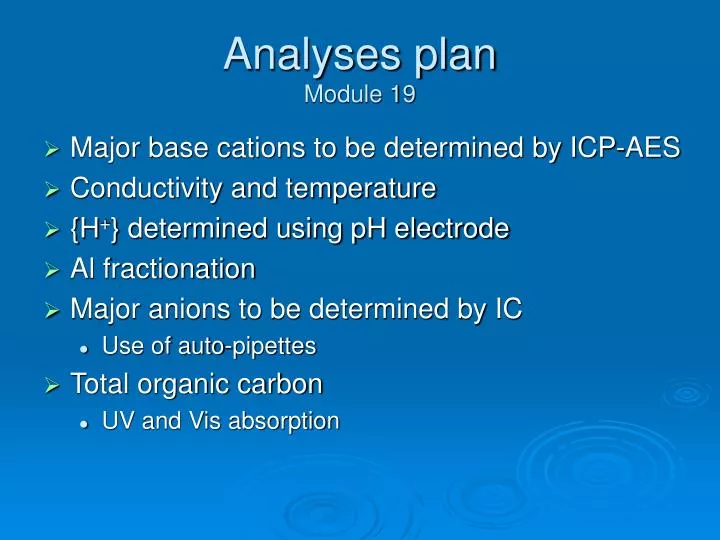
Analyses planModule 19 • Major base cations to be determined by ICP-AES • Conductivity and temperature • {H+} determined using pH electrode • Al fractionation • Major anions to be determined by IC • Use of auto-pipettes • Total organic carbon • UV and Vis absorption
Conductivity • Master student lab V160 • Ecoscan Con5 (Eutech instruments) conductivity meter. • The instrument is calibrated using 1000 and 1433 µS calibration solutions • The measurements are done for quality control purposes in order to compare measured and calculated conductivity
{H+} determined using pH electrode • Analytical Chemistry lab Ø109 • Thermo Orion model 720 pH-meter with a Blueline 11-pH electrode. • The pH-meter is calibrated with pH = 4.00 and 7.01 buffer solutions
Major base cations to be determined by ICP-AES • Ca2+, Mg2+, Na+, K+ • Method will be demonstrated in Module 24 • Appropriate calibration solutions are prepared by Masha • Conducted by Anne-Marie Skramstad
Major anions to be determined by Ion Chromathograph (IC) • Analytical Chemistry lab Ø109 • Tot-F, Cl-, NO3-, SO42- • Principle • The sample is injected in a flow of eluent • The analyte ions are separated by different degree of binding to the active sites on the ion exchange material • Ions with opposite charge of the analyte is exchanged with H+ or OH- • The activity of the analyte is and accompanied H+ or OH- in the eluent stream is measured by means of a conductometer • Presented by Hege Lynne et al
Total organic carbon • Analytical chemistry lab Ø 104 • High temperature (680C) catalytic combustion analysis on a Shimadzu TOC-5000A instrument • Principle: • The organic carbon is combusted to CO2 by high temperature and catalysis. The amount of CO2 produced is measured using av IR detector • Presented by Hege Lynne et al. • Analytes measured may include: TC, IC, TOC, NPOC, and POC
Al fractionation • Master student lab V160 • Method presented as example in Lecture 1 (slide 15) • Download manual from • http://folk.uio.no/rvogt/KJM_MEF_4010/
QC of data • After the analysis the data must be compiled and quality controlled by ion balance and agreement between measured and calculated conductivity • For this purpose you may use the Data compilation and QC worksheet available at http://folk.uio.no/rvogt/KJM_MEF_4010/
Speciesin natural freshwaterCentral equilibriums in natural water samples KJM MEF 4010 Module 19
Inorganic complexes • Major cations in natural waters • H+, Ca2+, Mg2+, Na+, K+ • Common ligands in natural systems: • OH-, HCO3-, CO32-, Cl-, SO42-, F- & organic anions • In anoxic environment: HS- & S2- • Dominating species in aerobic freshwater at pH 8 are:
Hydrolysis • In aqueous systems, hydrolysis reactions are important • Hydrolysis reactions are controlled by {H+} • The higher the pH, the stronger the hydrolysis of metal cations • E.g. Aluminium • Al3+aq denotes Al(H2O)63+
Concentrations of dissolved Fe3+ speciesTwo total Fe concentrations, FeT = 10-4M and FeT = 10-2M
Dissolved Organic Matter • Low molecular weight (LMW) • < 1000Da (e.g. C32H80O33N5P0.3) • E.g.: • High molecular weight • 1000 - > 100 000Da • Humic substance • Very complex and coloured substances • Enhances weathering • The protolyzation of weak organic acids • Complexation of Al and Fe • Total congruent dissolution
Activity • {X}=X · [X] • {X} is the activity to X • [X] is the concentration to X • X is the activity coefficient to X • X are dimensionless • It is determined by: • The diameter (å) of the hydrated X • Its valence (nX) • The ionic strength (I) Not possible to calculate further than I=0.1 n=1 n=2 n=3 n=4 • when I 0 1 when I<10-5M Anions + cations
Debye Huckel(DH) equation • For ionic strengths (I) < 0.1M the X can be calculated by means of e.g. the Debye Huckel equation: I < 0.1 I < 0.005 • 0.5 & 0.33 are temperature dependent table values • Presented values are for 25°C • åX is a table value for the specie in question