Download
1 / 15
150 likes | 228 Vues
Discover the main functions of the skeletal system, including protection, blood cell formation, and movement. Learn about bone structure, joints, strengths, weaknesses like arthritis and osteoporosis, cures, and how to maintain a healthy skeleton. Enjoy interesting facts and review questions to test your knowledge.

E N D
The Skeletal System KavittaGhai, Shefali Mathrani, Rebecca Ryan
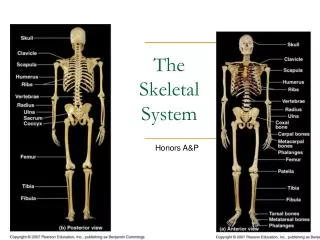
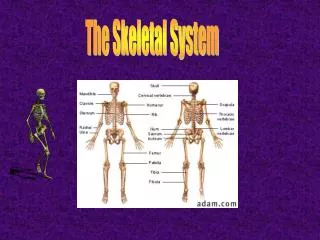
Main Functions • Protection & Support • Skeleton protects internal organs and fragile body tissues • Provides framework for body • Allows us to keep our shape • Blood cell formation • Red bone marrow produces red and white blood cells • Stores minerals and energy • Bone tissues stores calcium and phosphorus • When required, minerals are released into the blood • Yellow bone marrow stores chemical energy and fat • Aids movement • Works with muscular system to allow body to move
How It Works • Protection and Support: • Cranium protects brain and eyes • Ribs protect heart and lungs • Vertebrae protects spinal cord • Production of blood cells: • Red marrow produces blood cells, platelets and most white blood cells • Some white blood cells develop in yellow marrow • Cases of severe blood loss: body can convert yellow marrow to red marrow to increase blood cell production. • Movement: • Muscles attached to bones through tendons • Bones and muscles work together by impulses and signals • Nervous system signals muscle to contract • Muscle contracts, bone moves with it
What Are Bones? • Hard, whitish tissue making up the skeleton • Considered living organs • Made of epithelial tissue—the thin tissue that forms the outer layer of a body's surface, nerves, muscle tissue and connective tissue • Grow and change as your body mature
What Makes Up Bones • Periosteum: thin, dense membrane that lines the outer surface of bones and contains nerves and blood vessels to nourish bone • Compact Bone: smooth and very hard part of bone, blood vessels run through it • Cancellous Bone (Spongy Bone): looks like sponge because has large open spaces, not as hard as compact bone, protects bone marrow • Bone Marrow: produces blood cells and stores energy
Joints • Immovable Joints: connected by connective tissue, do not allow movement • Slightly Movable Joints: joined together by cartilage • Freely Movable Joints: joined by cartilage and cushioned cavities filled with synovial fluid
Strengths • Muscles and bones enable body to move • Bones are strong because of calcium compounds • Marrow produces new blood cells and repairs old ones • Comprise only 18% of body weight
Weaknesses • Arthritis: disease of the joints, caused by destruction of cartilage between bones and joints • Scoliosis: abnormal curvature of the backbone, caused by disease that affects spine • Osteoporosis: disease of the bone, becomes thin so easy to fracture
Cures • Arthritis: Lifestyle changes, physical therapy, medication, and surgery • Scoliosis: braces or surgery • Osteoporosis: Proper diet, adequate calcium, medication, exercising
Weaknesses Cont. • Fractures: bone shatters • Torn ligaments: breakage of connective tissue which holds together bones and joints
Maintaining A Healthy Skeleton • Drink milk or take calcium supplements • Exercise; engage in weight-lifting • Maintain a healthy diet; orange juice, broccoli, fish, etc. • Keep teeth clean • Wear protection during sports
Interesting Facts • There are over 100 types of arthritis • Babies start out with 300-350 bones • There are 206 bones in the adult body • Scoliosis is more common in girls than boys
Review Questions • What part of the bone produces new blood cells as well as repairing damaged ones? • What are the three types of joins? • What covers and protects our major organs? • What kind of tissue do bones mainly consist of? • How many bones are in an adult body? • Name one way we can maintain the skeletal system.