
ELECTRICAL CIRCUITS
E N D
Presentation Transcript
ELECTRICAL CIRCUITS All you need to be an inventor is a good imagination and a pile of junk. -Thomas Edison
Current: continuous flow of electric charges through a material Low Current (high voltage) High Current (low voltage)
Voltage- difference in electric potential between two points (push that causes electrons to move) Low Voltage High Voltage
Resistance: measure of how difficult it is for charges to flow through the objects
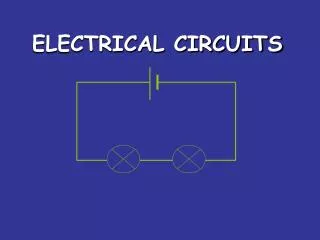
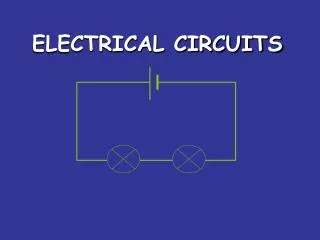
Simple Circuits • Series circuit • All in a row • 1 path for electricity • 1 light goes out and the circuit is broken • Parallel circuit • Many paths for electricity • 1 light goes out and the others stay on
circuit diagram Scientists usually draw electric circuits using symbols; Battery (cell) Light(resister) switch wires
Ohm’s Law • Simple analogy: Water in a hose • Electrons in a copper wire are analogous to water in a hose. • Consider the pressure valve as the applied voltage and the size of the hose as the source of resistance. • The absence of pressure in the hose, or voltage across the wire will result in a system without motion or reaction. • A small diameter hose will limit the rate at which water will flow, just as a small diameter copper wire limits the flow of electrons.
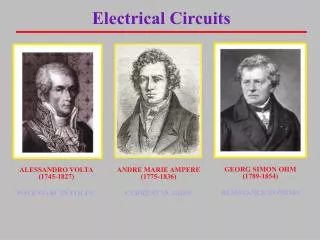
Ohm’s Law Voltage = Current x Resistance Current (amps)= Voltage Resistance Georg Simon Ohm (1787-1854)
Ohm’s Law Current (amps)= Voltage Resistance • the greater the voltage (or pressure) across a resistor, the more the current. • The more the resistance, for the same voltage, the less the current.
Lab Questions: 1. How did adding more voltage affect the current (speed of motor)? 2. How did adding more resistance (lights + motor) affect the current (speed)?
PARALLEL CIRCUIT • Place two bulbs in parallel. What do you notice about the brightness of the bulbs? • Add a third light bulb in the circuit. What do you notice about the brightness of the bulbs? • Remove the middle bulb from the circuit. What happened?
measuring current Electric current is measured in amps(A) using an ammeter connected in series in the circuit. A
measuring current This is how we draw an ammeter in a circuit. A A PARALLEL CIRCUIT SERIES CIRCUIT
measuring voltage The ‘electrical push’ which the cell gives to the current is called the voltage. It is measured in volts (V) on a voltmeter V