Diaspora and Governance
120 likes | 277 Vues
This course explores the multifaceted relationship between diaspora communities and governance, focusing on themes such as identity, engagement forms, and challenges. It highlights how diaspora involvement can yield significant benefits through remittances, investment, and social advocacy while addressing potential issues like class stratification and foreign influences. The Liberia case study serves as a critical example of leveraging diaspora support for national development, political engagement, and community resilience. Participants will examine best practices for maximizing diaspora contributions while minimizing conflicts.


Diaspora and Governance
E N D
Presentation Transcript
Diaspora and Governance Laura Hammond & RobtelPailey SOAS Mo Ibrahim Governance and Development Africa Residential Course May 2013 Accra, Ghana
Diaspora • Dispersal (traumatically?) of a population from an original homeland to 2 or more places, or expansion to new places • Collective memory/myth re: homeland • Continued or reinvigorated orientation towards a real or imagined homeland • Narrative of return, even if not all intend to do so • Strong ethnic group consciousness based on shared historical, ethnic, cultural, religious traits/experience • Identities based on boundary-maintenance vis-à-vis a host society • May include those born out of country of origin • Ties to co-ethnics in other countries (Adapted from Cohen 2008)
Forms of Diaspora Engagement • Remittances • Individual support • Development • Humanitarian relief • Investment (themselves and help in attracting non-nationals) • Returnees working in public, private sector • International lobbyingfor political ends • International (social)media engagement • National lobbying, support for specific political issues
Possible Problems • Take jobs away from locals • Drive up real estate prices, cost of living • Contribute to class stratification, may impact ethnic/religious differences • May introduce behaviour, values that are seen as foreign, unwelcome • ‘Diasporic nostalgia’ – lose touch with local realities
Efforts to maximize benefits from diaspora • Taxation of remittances • Selling of ‘Diaspora Bonds’ to fund development • Courting of diaspora for funding, political support • Rules re: national service for training • Rules re: investment, business ownership • Extraterritorial voting • Dual Citizenship Laws • Recruitment of skilled (and even unskilled) labour
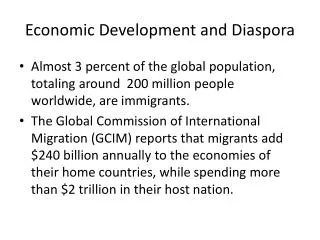
Remittances • $406 billion remitted to DCs in 2012 (WB) South-South remittance flows 30 - 45% of total remittances received by developing countries (2010) • Well targeted, efficient, effective • In some places costs are still high >7%
Types of Remittances • Financial Remittances • For household consumption • Community based (HTAs, local NGOs, social service providers) • Private investment • Social Remittances • Technical expertise, advice • Donation of time
Political Diasporas • Many diasporas are highly politicized • May influence politics, conflict situation both to inflame conflict or to build peace • Political advocacy abroad may be done through diaspora • Influences upon the diaspora may lead to political, economic, social change in country of origin – these influences can also clash sometimes
Part-time Diasporas & ‘Re-aspora’ • People maintaining multiple residences, participating on multiple stages • Parliaments, govt administrations, NGOs with diaspora members • Rely on fundraising from abroad, are often themselves the bridge to communities in country of origin • Access to power often through diaspora networks
Challenges for Governance • What is ideal level of diaspora involvement? • How to get the best from the diaspora without inviting political meddling/domination • For diaspora: how to achieve maximum acceptance • Listen to people, spend time learning what local priorities are