Understanding Midpoints, Distance, and Congruence in Geometry
This lesson explores critical concepts in geometry, including the definitions and applications of midpoints, distance formulas, and congruence. Key mathematical postulates, such as the Ruler and Segment Addition Postulates, are examined to establish foundational understanding. Students will learn to calculate the average of numbers, simplify solutions, and find values to the nearest hundredth. Through examples and practice problems, we will solidify these concepts, enhancing our ability to solve geometric problems effectively.

Understanding Midpoints, Distance, and Congruence in Geometry
E N D
Presentation Transcript
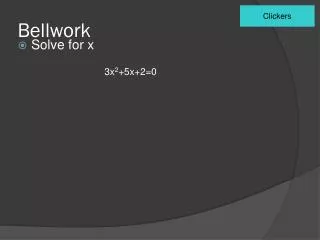
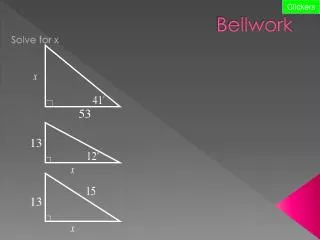
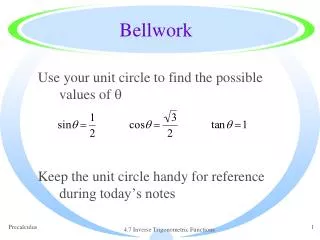
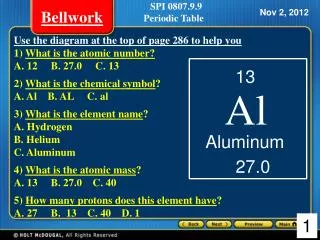
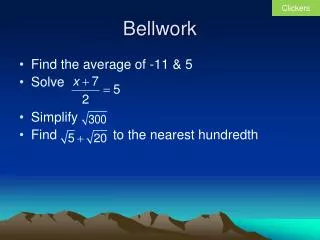
Clickers Bellwork • Find the average of -11 & 5 • Solve • Simplify • Find to the nearest hundredth
Bellwork Solution • Find the average of -11 & 5
Bellwork Solution • Solve
Bellwork Solution • Simplify
Bellwork Solution • Find to the nearest hundredth
Segments and Congruence & Use Midpoint and Distance Formulas Sections 1.2 &1.3
The Concept • Today we’re going to start with the idea of congruence and continue onto two monumental yet simple postulates • We will then see the definition for a midpoint and the formula for finding it • We’ll also learn the formula for finding the length of a line via the distance formula
Definitions • Postulate • Rule that is accepted without proof • Can also be called an axiom Rule that is accepted without proof Postulate 1.2 Axis of symmetry Vertex
Ruler postulate • This postulate explains that two points on a line can be explained as two coordinates • The distance between the two coordinates correlates to the length of the segment A B x1 x2
Ruler Postulate uses • One use is if we assign values to the coordinates A B x1 (2,0) (12,0) x2 • Or it can be used to allow the use of a ruler to find the length of a segment • Seems nonsensical, but again is something that must be explained in order to base further exploration
Segment Addition Postulate • This postulate explains that two connected segments created by a point between two others can be added together to get the full distance • It can also be used to explain interior points • If B is between A & C then AB+BC=AC • If AB+BC=AC, then B is between A and C A B C
Segment Addition Postulate use • Based on this postulate find the length of BC, if AC=32 A B C 13
Congruence • Congruence • The same measure as • AB is congruent to CD • Written as • Important that congruence is used in lieu of equals
Nomenclature • At this point we should also discuss the two different nomenclatures you may see regarding segments • This denotes the segment AB • This denotes the length of segment AB
Use of Congruence • Given the following points are XY and WZ congruent? • X: (-2, -5) • Y: (-2, 3) • W: (-4,3) • Z: (4, 3)
Definitions • Midpoint • The point on a line segment that lies exactly halfway between the two endpoints • Divides the segment into two congruent pieces • The point on a line segment that lies exactly halfway between the two endpoints • Divides the segment into two congruent pieces C B Midpoint 1.3 A Axis of symmetry Vertex
Finding a midpoint • How do we find a midpoint? • We simply divide the length by two • AB is 20 • What is AC? A C B
Example If point X is the midpoint of segment JK and the length of JX is 14.5, what length of segment JK? J X K
Bisectors • If a line, ray or segment goes through the midpoint of another segment, it is called the bisector of the segment D A B E C
Showing congruence • We are able to show congruence of segments in a figure through the use of slash marks • Using the same diagram, in which segment AB is bisected D A B E C
Midpoints • What happens if we put a line on the coordinate plane? • How do we find the midpoint? • We can use a derivation of the ruler principle to find the midpoint of a line on the coordinate axis… • The formula is (x2,y2) B (x1,y1)
Where does this come from? • How did we get this formula? (x2,y2) B y2 (x1,y1) ½ (y1+y2) ½(x1+x2) x2
Click-In • What is the midpoint of a line segment that goes from (1, 2) to (11,20)?
Long Distance Call In addition to finding the midpoint of a line when on the coordinate plane, we can also find the distance or length of the segment using the ruler postulate and the pythagorean theorem • The ruler postulate gives us length, but only in one dimension • The Pythagorean Theorem gives us the length of the hypotenuse of a triangle if we have the length of the two sides • So…we use the ruler postulate to figure the two lengths and then apply the Pythagorean theorem • Let’s take a look…
Where does this come from? • How did we get this formula? (x2,y2) c b= y2-y1 (x1,y1) a= x2-x1 Why is there not a plus or minus in front of this?
Example • Find the distance between (-10,2) & (4,1)
On your own • Find the distance between (-1,-1) & (10,2)
On your own • Find the distance between (3,3) & (-2,-2)
Homework • 1.2 • 1,6-12 even, 16-30 • 1.3 • 2-8, 20-22, 28-34 even, 43-45, 49
Most Important Points • Definition of Congruence • Segment addition postulate • Definition of Midpoint • Definition of Bisector • Showing congruency in segments • Midpoint Formula • Distance Formula