SlideServe
Menu
Préférences
© SlideServe · v2026

BELLWORK

nora-white avatar
9 diapositives · 244 Views · Nov 16, 2014

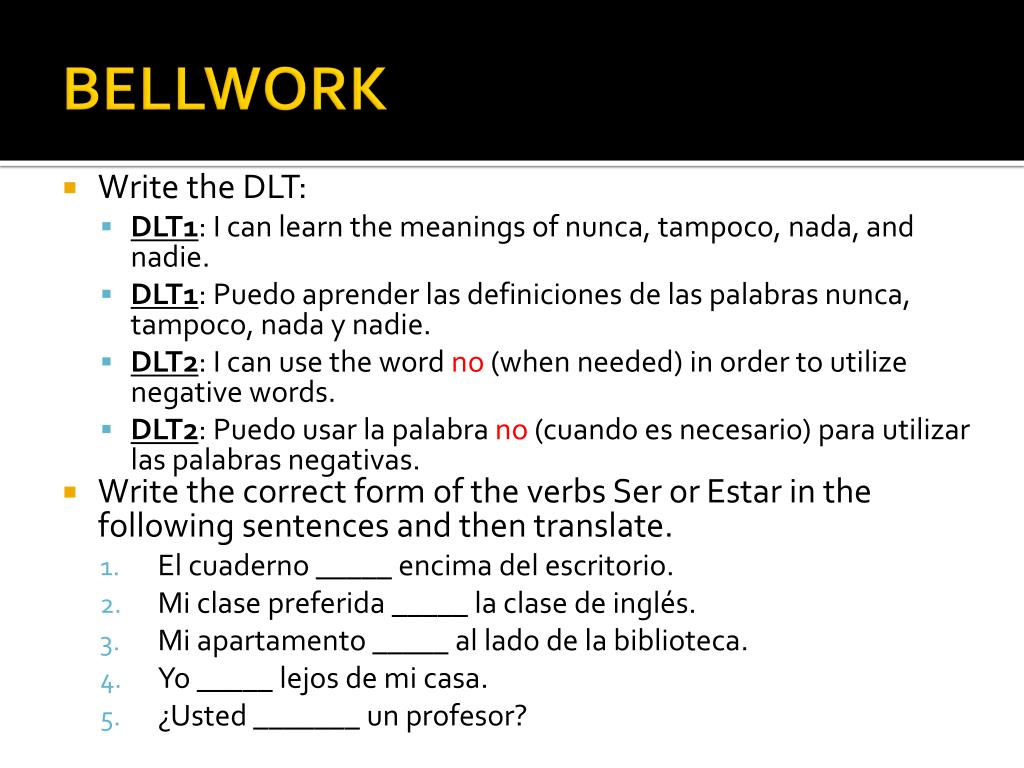
BELLWORK. Write the DLT: DLT1 : I can learn the meanings of nunca, tampoco, nada, and nadie. DLT1 : Puedo aprender las definiciones de las palabras nunca, tampoco, nada y nadie. DLT2 : I can use the word no (when needed) in order to utilize negative words.
BELLWORK - slide 1
01 / 9BELLWORK
1 / 17

Télécharger la présentation

BELLWORK
Une image / un lien ci-dessous est fourni (tel quel) pour télécharger la présentation

Politique de téléchargement : le contenu du site vous est fourni TEL QUEL pour votre information et votre usage personnel ; il ne peut être vendu, concédé sous licence ni partagé sur d’autres sites sans l’accord de son auteur.Le contenu vous est fourni TEL QUEL, pour votre information et votre usage personnel uniquement. Téléchargez la présentation en cliquant sur ce lien. Lors du téléchargement, si vous ne parvenez pas à télécharger une présentation, l’éditeur a peut-être supprimé le fichier de son serveur.Pendant le téléchargement, si vous ne parvenez pas à obtenir une présentation, le fichier a peut-être été supprimé par l’éditeur.

F I N

Plus de contenu associé

Transcription de la présentation
  1. BELLWORK • Write the DLT: • DLT1: I can learn the meanings of nunca, tampoco, nada, and nadie. • DLT1: Puedo aprender las definiciones de las palabras nunca, tampoco, nada y nadie. • DLT2: I can use the word no (when needed) in order to utilize negative words. • DLT2: Puedo usar la palabra no (cuando es necesario) para utilizar las palabras negativas. • Write the correct form of the verbs Ser or Estar in the following sentences and then translate. • El cuaderno _____ encima del escritorio. • Mi clase preferida _____ la clase de inglés. • Mi apartamento _____ al lado de la biblioteca. • Yo _____ lejos de mi casa. • ¿Usted _______ un profesor?

  2. Negation with nunca, tampoco, nadie, and nada

  3. Negative Words • In English, you are not suppose to use double negatives in a sentence: • For Example: It is Incorrect to say: There wasn’t nobody there. Instead, one should say: There wasn’t anybody there. • In Spanish, however, double negatives are commonly used in a sentence. • No hay nadiealli. • Therewasn’tanybody (nobody) there. • The following slide will show you the negative & positive words used in Spanish:

  4. Negative & Positive Words • No • Nunca • Siempre • Tampoco • También • Nada • Algo • Nadie • Alguien • Don’t/Do Not • Never (ever) • Always • Neither/Not Either • Also • Nothing (Not anything) • Something • Nobody/Not Anybody • Someone/Somebody

  5. Negative Words (pg. 176) • Negative words in Spanish can take the place of the word noor can be added toward the end of a sentence that already has no. Novoy a la clase. Nuncavoy a la clase. Novoy a la clasenunca. • The words nada and nadie can both be used as a subject in a sentence in which case they are placed before the verb. Nada esfacíl Nadiequieresacar la basura. • When nada and nadie are used after the verb, no must be placed before the verb. No quierohacernada. No hay nadieen clase hoy.

  6. Exit Slip • Page 177 • Activity28 • Rewrite the entire phrase with the correct word in parenthesis • translate the completed phrase • Rewrite the sentences in Activity 28 in Spanish giving the oppositemeaning

  7. Activity 28 • Mis primos no van a la playa. No voy a la playa tampoco. My cousins don’t go to the beach. I don’t go to the beach either. • No quiero hacer nada hoy. I don’t want to do anything today. • Mis padres, mis hermanos y yo tenemos el pelo castaño. Nadie en mi familia tiene el pelo rubio. My parents, my siblings, and I have brown hair. Nobody in our family has blond hair. • Cuando llueve y hace frio, mi perro no quiere salir. A mí tampoco me gusta salir cuando hace mal tiempo. When it rains and it is cold, my dog doesn’t want to go out. I don’t want to go out when the weather is bad either. • Siempre preparamos la cena en la cocina. Nunca cocinamos en el patio. We always prepare dinner in the kitchen. We never cook on the patio. • Después de cenar, me toca lavar los platos. Nadie me ayuda. After dinner it is my turn to wash the dishes. No one helps me.

  8. Activity 28 • Mis primos van a la playa. Voy a la playa también. • Quiero hacer algo hoy. • Mis padres, mis hermanos y yo tenemos el pelo castaño. Alguien en mi familia tiene el pelo rubio. • Cuando llueve y hace frio, mi perro quiere salir. A mí también me gusta salir cuando hace mal tiempo. • Nunca preparamos la cena en la cocina. Siempre cocinamos en el patio. • Después de cenar, me toca lavar los platos. Alguien me ayuda.

  9. Activity 29 -¿Vas a hacer algo el sabado? -Are you going to do anything Saturday? -No, no voy a hacer nada. ¿Y tú? -No, I am not going to do anything. And you? -Casi siempre voy al cine los sabados. ¿Quieres ir conmigo? -I almost always go to the movies on Saturdays. Do you want to come with me? -Sí, yo tambien quiero ir al cine. ¿Sales mucho los sabados? -Yes, I also want to go to the movies. Do you go out a lot on Saturdays? - Sí. Casi nunca paso los fines de semana en casa. -Yes. I almost never spend the weekends at home. -Yo tampoco paso los fines de semana en casa. Siempre salgo con mis amigos y mis primos. -I don’t spend time at home on the weekends either. I always go out with my friends and cousins.