Understanding Arthropods: Characteristics, Diversity, and Specifics of Crustaceans
Discover the fascinating world of arthropods, including lobsters, crabs, crayfish, spiders, and insects. Members of the Phylum Arthropoda are segmented and possess jointed appendages such as legs and antennae. This chapter covers essential characteristics such as the exoskeleton's structure and the open circulatory system. It delves into the molting process and the unique features of crustaceans, including their diverse habitats and adaptations. Learn about their neural control, digestion, respiration, and sensory systems for a comprehensive understanding of these remarkable creatures.

Understanding Arthropods: Characteristics, Diversity, and Specifics of Crustaceans
E N D
Presentation Transcript
Chapter 36 Section 1 Arthropoda
Characteristics • Lobsters, crabs, crayfish, spiders, & insects • Arthropods- members of the Phylum Arthropoda • Segmented animals with appendages- such as legs & antennae • Arthropod means “jointed foot
Characteristics • Exoskeleton- protection & support • 3 layers of exoskeleton • Outer- waxy/protein- prevents water loss and drying out • Middle- protection layer made of protein & chitin- tough carbohydrate • Inner-flexible/muscles-movement
Characteristics • Cephalization- brain/sensory structures located at anterior end • Appendages around mouth to aid with feeding • Antennae specialized for detecting chemicals
Characteristics • Open circulatory system • Compound eyes- eyes made of many individual light detectors with lenses
Molting • Molting- shedding of the exoskeleton to grow • Hormones trigger molting • Arthropods usually hide during this stage because they are vulnerable to predators
Evolution & Classification • Trilobites- ancient & extinct arthropod • Tagma- specialized for feeding, locomotion, & reproduction • Two major mouthparts: mandibles- jaw-like chelicerae- pincer-like
REVIEW!!! • Name three characteristics of arthropods. • Why do arthropods molt?
Chapter 36 Section 2 Subphylum Crustacea
Characteristics • Two-pairs of antennae • Mandibles • Pill bugs, lobster, crayfish • Nauplius- free-swimming larva stage
Diversity of Crustaceans • Range of sizes, but most are small • Copepods- no larger than a comma ( , ) • Japanese spider crab- 13 feet
Aquatic Crustaceans • Copepods- marine (plankton) • Water fleas (Daphnia)- freshwater • Barnacles- marine- sessile; attach to many different surfaces • Cirri- appendages that sweep food particles into barnacle’s mouth
Terrestrial Crustaceans • Isopods- pill or potato bug • Lose water quickly through thin exoskeleton • Live in moist environments • Roll into a ball when threatened as a defense • Feed on decaying vegetation
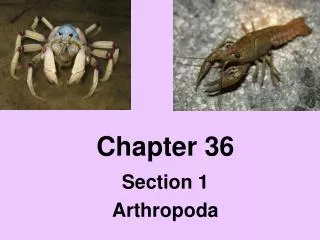
Crayfish • Freshwater crustacean • Similar to lobster • Well-studied because of abundance • Decapods- crayfish, lobster, crab, & shrimp (10-feet)
External Structure • Body divided into abdomen & cephalothorax- consists of head & thorax- eight segments & lies behind head • Carapace- dorsal exoskeleton • Abdomen- six segments behind cephalothorax
External Structure • Two pairs of antennae- touch & taste • Antennules- touch, taste, balance • Mandibles- chew food • Maxillae- manipulate food & draw water over gills • Maxillipeds- manipulate food
External Structure • Cheliped- capture food & pincer defense • Swimmeret- creating water current & transferring sperm • Telson & uropods- paddle-like tail • Move in backward movement called “tail flip”
Digestion • Esophagus stomach teeth-like structures in stomach grind food to fine paste mixed with enzymes secreted by digestive gland enters intestine for digestion & absorption anus
Respiration • Feather-like gills for respiration • As crayfish walk, circulate water over gills
Circulation • Open-circulatory system • Circulatory fluid called hemolymph • Exchanges carbon dioxide with oxygen in water • Gills dorsal part of crayfish heart
Excretion • Green glands- excess water, along with wastes is eliminated • Waste from green glands leaves through a pore at the base of the antennae
Neural Control • Ganglia • Controls mandibles, maxillae, & maxillipeds • Ventral nerve cord runs from the ganglia into the thorax & abdomen
Sensory Organs • Sense vibrations & chemicals by sensory hairs over entire body • Compound eye sense light
REVIEW!!! • Name three appendages of the crayfish and the function of each appendage. • How do crayfish digest food? • How do crayfish sense their environment?