GBM Status
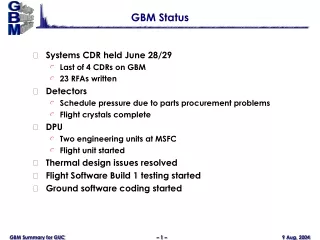
As of the last of four Critical Design Reviews (CDRs) held on June 28/29 for the GBM project, 23 RFAs were written, and significant progress was made, including completion of flight crystals and resolution of thermal design issues. However, challenges such as pressure on the schedule due to parts procurement issues and a shortfall in FY2005 funding were noted. Flight software testing has begun, but several problems, including FSW crashes, have emerged, mainly related to power supply. The capability for Earth-occultation technique to be used as an all-sky monitor remains a topic of discussion, amid resource limitations.

GBM Status
E N D
Presentation Transcript
GBM Status • Systems CDR held June 28/29 • Last of 4 CDRs on GBM • 23 RFAs written • Detectors • Schedule pressure due to parts procurement problems • Flight crystals complete • DPU • Two engineering units at MSFC • Flight unit started • Thermal design issues resolved • Flight Software Build 1 testing started • Ground software coding started
Significant Future Milestones Contingency for Delivery to SC: ~60 days
GBM Issues • FY2005 Funding • Shortfall due to full cost accounting and unanticipated expenses • Prospects good for additional funds • FSW crashes • Appear to be several causes • Most difficult appear to be power supply related • NaI performance • Silicone pad 0.7 mm thick behind entrance window • Transmission at 10 keV is ~25% • We will not reach goal of 5 keV
GBM as an All-Sky Monitor • Idea is to use Earth-occultation technique as was done with BATSE • GBM has lower sensitivity but also lower energy threshold • RFA submitted at the Science Requirements Review to make this capability a GBM requirement – not accepted • GBM hasn’t the resources to do this gratis • Appropriate as a guest investigation • Desirable to have in place at launch