Babylonians
This overview explores the remarkable advancements achieved by various civilizations, emphasizing the Babylonians' innovations in mathematics and astronomy, the Ancient Greeks' contributions to philosophy and their cultural legacy, and the pivotal developments during the Middle Ages and the Renaissance. We highlight key figures such as Plato and Newton, the significance of the House of Wisdom, and the transformative impact of the Industrial Revolution on society, technology, and living conditions. This narrative reveals the interconnectedness of historical progress and human achievement.

Babylonians
E N D
Presentation Transcript
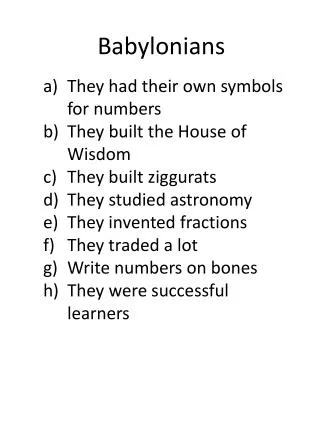
They had their own symbols for numbers They built the House of Wisdom They built ziggurats They studied astronomy They invented fractions They traded a lot Write numbers on bones They were successful learners Babylonians
They had their own symbols for numbers • They built the House of Wisdom • They built ziggurats • They studied astronomy • They invented fractions • They traded a lot • Write numbers on bones • On clay tablets • They were successful learners Babylonians
Ancient Greeks • Plato had the idea of the perfect forms • Their mathematicians included, Thales, Archimedes, Pythagoras • They held the Olympics • They made beautiful flower pots • They were good fighters • The Olympics were held • They made beautiful sculptures • They had great libraries • They created a printing press
Ancient Greeks • Plato had the idea of the perfect forms • Their mathematicians included, Thales, Archimedes, Pythagoras • They held the Olympics • They made beautiful flower pots Vases but they weren’t used for flowers (water and wine instead) • They were good fighters • The Olympics were held • They made beautiful sculptures • They had great libraries Just one – in Alexandria • They created a printing press
Middle Ages • The House of Wisdom was built • The Black Death was spread by fleas • Medicine in Europe improved significantly • It was the beginning of philosophy • Islamic countries were more developed than Europe • People were very superstitious • England frequently invaded other countries • The Muslims used the stars to indicate where they were • Henry VIII was around
Middle Ages • The House of Wisdom was built • The Black Death was spread by fleas • Medicine in Europe improved significantly Medicine in Europe was rubbish! • It was the beginning of philosophy The Greeks?! • Islamic countries were more developed than Europe • People were very superstitious • England frequently invaded other countries • The Muslims used the stars to indicate where they were • Henry VIII was around
Renaissance • Newton discovered the laws of gravity • Einstein built on earlier discoveries to develop the laws of gravity • There were discoveries in Africa • Mathematicians included Leibniz andPascal • People were very religious • People began to believe that humans were beautiful and study the human body • Leonardo da Vinci was born • People worked in factories • They made a lot of machinery • They created books
Renaissance • Newton discovered the laws of gravity • Einstein built on earlier discoveries to develop the laws of gravity • There were discoveries in Africa • Mathematicians included Leibniz andPascal • People were very religious • People began to believe that humans were beautiful and study the human body • Leonardo da Vinci was born • People worked in factories • They made a lot of machinery • They created books They created the printing press
Industrial Revolution • Factories were significant • A computer was designed • There was lots of pollution and smog which caused poor health • Many kids didn’t live beyond five • There were many coal mines • Trains were invented • There were fewer farms and less open space • London was highly populated due to jobs • Electricity powered the lights
Industrial Revolution • Factories were significant • A computer was designed Babbage designed a computer • There was lots of pollution and smog which caused poor health • Many kids didn’t live beyond five • There were many coal mines • Trains were invented • There were fewer farms and less open space • London was highly populated due to jobs • Electricity powered the lights Only in a handful of places right at the end of the Industrial Revolution – most public lights were gas lamps
Twentieth century • World War I and World War II happened • Charles Babbage helped to invent the first computers • The first televisions were invented • Fermat’s Last Theorem was solved by Andrew Wiles • Humans used Apollo 11 to land on the moon for the first time • Turing broke the Enigma Code • Intricate building designs • Advances in technology • There were massive slums in England
Twentieth century • World War I and World War II happened • Charles Babbage helped to invent the first computers 19th century • The first televisions were invented • Fermat’s Last Theorem was solved by Andrew Wiles • Humans used Apollo 11 to land on the moon for the first time • Turing broke the Enigma Code • Intricate building designs True for many other times in history • Advances in technology True for many other times in history • There were massive slums in England True, but more true for the Industrial Revolution than 20th century