Independent and Dependent Clauses
110 likes | 708 Vues
Learn the difference between independent and dependent clauses and how to properly connect them for effective writing. Explore coordinating conjunctions and independent marker words. Proper punctuation examples provided.


Independent and Dependent Clauses
E N D
Presentation Transcript
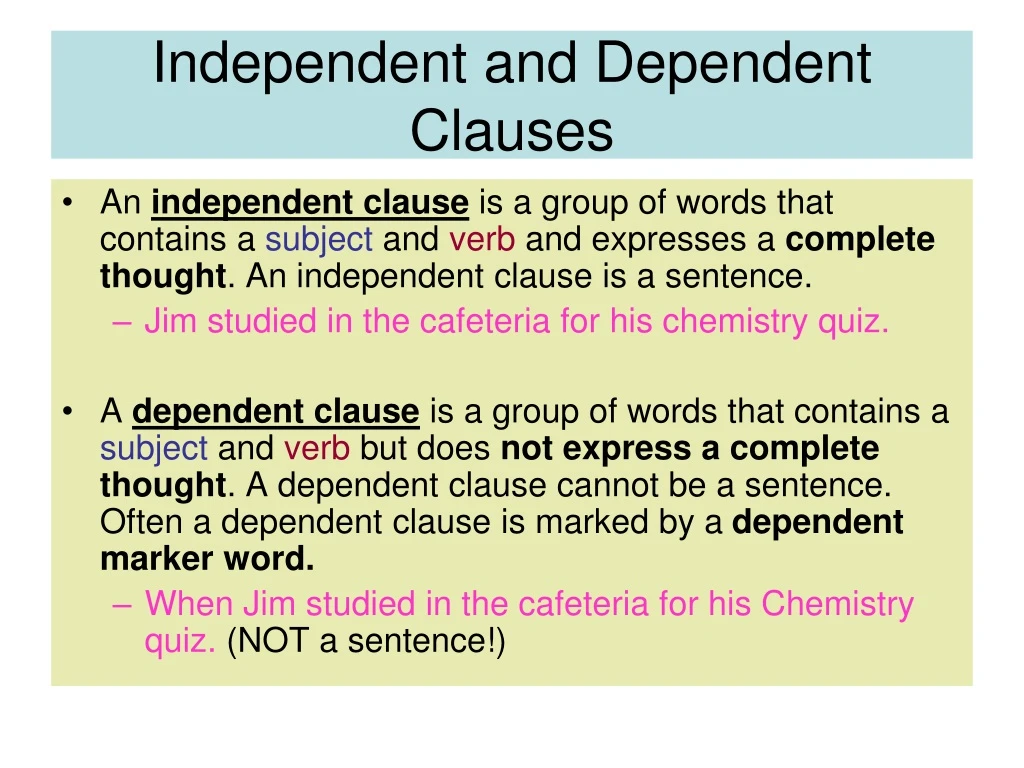
Independent and Dependent Clauses • An independent clause is a group of words that contains a subject and verb and expresses a complete thought. An independent clause is a sentence. • Jim studied in the cafeteria for his chemistry quiz. • A dependent clause is a group of words that contains a subject and verb but does not express a complete thought. A dependent clause cannot be a sentence. Often a dependent clause is marked by a dependent marker word. • When Jim studied in the cafeteria for his Chemistry quiz. (NOT a sentence!)
Dependent Marker Words • A dependent marker word is a word added to the beginning of an independent clause that makes it into a dependent clause. Examples: • WhenJim studied in the cafeteria for his chemistry quiz. (NOT a sentence!) • Some common dependent markers are:after, although, as, as if, because, before, even if, even though, if, in order to, since, though, unless, until, whatever, when, whenever, whether, and while
Connecting dependent and independent clauses • There are two types of words that can be used as connectors at the beginning of an independent clause: • Coordinating conjunctions • Independent marker words
Coordinating Conjunctions • Coordinating conjunctions are used as connecting words at the beginning of an independent clause. • They are: for, and, nor, but, or, yet, & so. (FANBOYS) • When the second independent clause in a sentence begins with a coordinating conjunction, a comma is needed before the coordinating conjunction: • Example: Jim studied in the cafeteria for his chemistry quiz, but it was hard to concentrate because of the noise.
Independent Marker Word • Some common independent marker words are: also, consequently, furthermore, however, moreover, nevertheless, and therefore. • An independent marker word is a connecting word used at the beginning of an independent clause. • These words can always begin a sentence that can stand alone. • When the second independent clause in a sentence has an independent marker word, a semicolon is needed before the independent marker word. • Example: Jim studied in the cafeteria for his chemistry quiz; however, it was hard to concentrate because of the noise.
Proper PunctuationHere are some examples of ways to combine independent and dependent clauses properly.