Total Solar Eclipse Observations and Equipment at the 32nd IOTA Annual Meeting
This document outlines the primary goals and methods for observing the August 21, 2017, total solar eclipse as discussed at the 32nd IOTA Annual Meeting on July 13, 2014. Key objectives include long-term solar radius measurement, standardization of video equipment and solar filters, and employing narrow band filters for precise measurements. The methodology leverages Baily's Beads for diameter changes, calibrating with Picard satellite data. Equipment specifications are provided, including telescope aperture, solar filters, and video camera types, aimed at accurately calculating the solar diameter and enhancing observational standards.

Total Solar Eclipse Observations and Equipment at the 32nd IOTA Annual Meeting
E N D
Presentation Transcript
August 21, 2017 Total Eclipse Plans Richard Nugent 32nd IOTA Annual Meeting July 13, 2014
Primary goals for this eclipse • Continuation for IOTA’s long term solar radius measurement research • Standardization of video equipment • Standardization of solar filters • 2nd use of narrow band filters • Results: calibrate with Picard satellite data
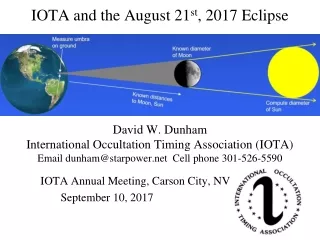
Measure umbra on ground Known diameter of Moon Known distances to Moon, Sun Compute diameter of Sun IOTA’s Method for Solar Radius Calculation
Equipment Specifications • Telescope aperture: 75mm – 100mm • Field of View – 15' - 20' • Solar filter – Baader brand – in sheets • Narrow band filters – Wratten #23, #56 • Video camera: PC164C(EX-2), Watec 902H
Narrow Band Filters Picard satelliteSODISM* bands for diameter/shape measurements are: 535nm, 607nm, 782nm *Solar Diameter Imager and Surface Mapper
Narrow Band filters acquired and distributed by Richard Nugent #23a #56
PC-164CEx-2 Watec 902H2
0.5km 0.5km
Ted Swift, S. limit 15 sec interval