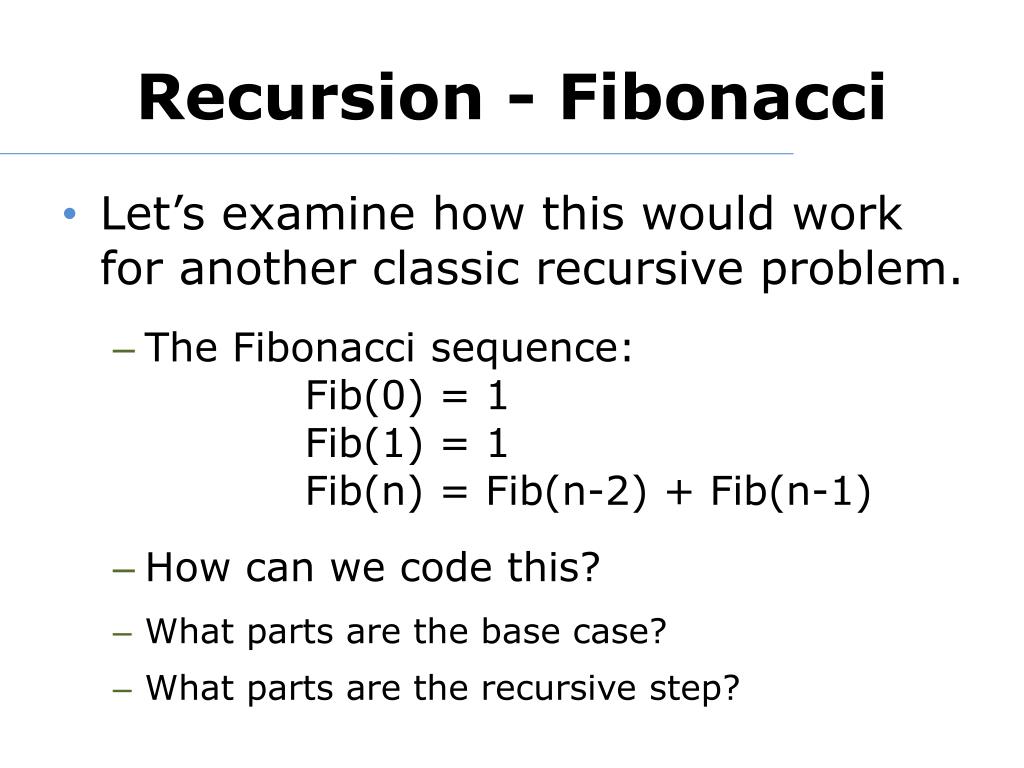
Recursion - Fibonacci • Let’s examine how this would work for another classic recursive problem. • The Fibonacci sequence: Fib(0) = 1 Fib(1) = 1 Fib(n) = Fib(n-2) + Fib(n-1) • How can we code this? • What parts are the base case? • What parts are the recursive step?
Recursion - Fibonacci int fibonacci(int n) { if(n == 0 || n == 1) return 1; else return fibonacci(n-2) + fibonacci(n-1); }
res: n: pos: part: Recursion - Fibonacci int fibonacci(int n) { if(n == 0 || n == 1) return 1; else A: return fibonacci(n-2) + B: fibonacci(n-1); } We’ll use the below graphics to aid our analysis of this method.
n: pos: part: 3 A --- res: n: pos: part: 1 5 A --- Recursion - Fibonacci if(n == 0 || n == 1) return 1; else A: return fibonacci(n-2) + B: fibonacci(n-1);
n: pos: part: 2 A --- n: pos: part: 3 B 1 res: n: pos: part: 1 5 A --- Recursion - Fibonacci if(n == 0 || n == 1) return 1; else A: return fibonacci(n-2) + B: fibonacci(n-1);
n: pos: part: 2 B 1 n: pos: part: 3 B 1 res: n: pos: part: 1 5 A --- Recursion - Fibonacci if(n == 0 || n == 1) return 1; else A: return fibonacci(n-2) + B: fibonacci(n-1);
n: pos: part: 3 B 1 res: n: pos: part: 2 5 A --- Recursion - Fibonacci if(n == 0 || n == 1) return 1; else A: return fibonacci(n-2) + B: fibonacci(n-1);
res: n: pos: part: 3 5 A --- Recursion - Fibonacci if(n == 0 || n == 1) return 1; else A: return fibonacci(n-2) + B: fibonacci(n-1);
n: pos: part: 2 A --- n: pos: part: 4 A --- res: n: pos: part: … 5 B 3 Recursion - Fibonacci if(n == 0 || n == 1) return 1; else A: return fibonacci(n-2) + B: fibonacci(n-1);
n: pos: part: 2 A --- n: pos: part: 4 A --- res: n: pos: part: … 5 B 3 Recursion - Fibonacci Didn’t we already get an answer for n = 2? Yep. So I’ll save us some time. if(n == 0 || n == 1) return 1; else A: return fibonacci(n-2) + B: fibonacci(n-1);
n: pos: part: 4 A --- res: n: pos: part: 2 5 B 3 Recursion - Fibonacci if(n == 0 || n == 1) return 1; else A: return fibonacci(n-2) + B: fibonacci(n-1);
n: pos: part: 3 A --- n: pos: part: 4 B 2 n: pos: part: 5 B 3 Recursion - Fibonacci Didn’t we already get an answer for n = 3? Yep. So I’ll save us some time. if(n == 0 || n == 1) return 1; else A: return fibonacci(n-2) + B: fibonacci(n-1);
n: pos: part: 4 B 2 res: n: pos: part: 3 5 B 3 Recursion - Fibonacci Didn’t we already get an answer for n = 3? Yep. So I’ll save us some time. if(n == 0 || n == 1) return 1; else A: return fibonacci(n-2) + B: fibonacci(n-1);
res: n: pos: part: 5 5 B 3 Recursion - Fibonacci if(n == 0 || n == 1) return 1; else A: return fibonacci(n-2) + B: fibonacci(n-1);
res: 8 Recursion - Fibonacci if(n == 0 || n == 1) return 1; else A: return fibonacci(n-2) + B: fibonacci(n-1);
Recursion - Fibonacci • Can this be done more efficiently? • You betcha! First off, note that we had had to recalculate some of the intermediate answers. • What if we could have saved those answers? • It’s possible, and the corresponding technique is called dynamic programming. • We’ll not worry about that for now.
Recursion, pt. 2: Thinking it Through
Sorting • One classic application for recursion is for use in sorting. • What might be some strategies we could use for recursively sorting? • During the course introduction, a rough overview of quicksort was mentioned. • There are other divide-and-conquer type strategies.
Merge Sort • One technique, called merge sort, operates on the idea of merging two pre-sorted arrays. • How could such a technique help us?
Merge Sort • One technique, called merge sort, operates on the idea of merging two pre-sorted arrays. • If we have two presorted arrays, then the smallest overall element must be in the first slot of one of the two arrays. • It dramatically reduces the effort needed to find each element in its proper order.
Merge Sort • Problem: when presented with a fresh array, with items in random order within it… how can we use this idea of “merging” to sort the array? • Hint: think with recursion! • Base case: n = 1 – a single item is automatically a “sorted” list.
Merge Sort • We’ve found our base case, but what would be our recursive step? • Given the following two sorted arrays, how would we merge them into a single sorted array? [13] => [13 42] [42]
Merge Sort • Given the following two sorted arrays, how would we merge them into a single sorted array? [-2, 47] => [-2, 47, 57, 101] [57, 101]
Merge Sort • Given the following two sorted arrays, how would we merge them into a single sorted array? [13, 42] => [7, 101] 7, 13 42 [ , , , ] 101
Merge Sort • Can we find a pattern that we can use to make a complete recursive step?
Merge Sort • Given the following two sorted arrays, how would we merge them into a single sorted array? [13, 42] => [7, 101] 7, 13 42 [ , , , ] 101
Merge Sort • In words: • If both lists still have remaining elements, pick the smaller of the first elements and consider that element removed. • If only one list has remaining elements, copy the remaining elements into place. • This is the recursive step of merge sort.
Merge Sort 13 32 77 55 43 1 42 88 [13 32 77 55],[43 1 42 88] [13 32],[77 55],[43 1],[42 88] ||| [13 32],[55 77],[ 1 43],[42 88] [13 32 55 77],[ 1 42 43 88] [1 13 32 42 43 55 77 88]
Merge Sort • Note that for each element insertion into the new array, only one element needs to be examined from each of the two old arrays. • It’s possible because the two arrays are presorted. • The “merge” operation thus takes O(N) time.