
SlideServe
Menu
Préférences
© SlideServe · v2026

Molecular weight

jorn avatar
23 diapositives · 487 Views · Aug 10, 2014

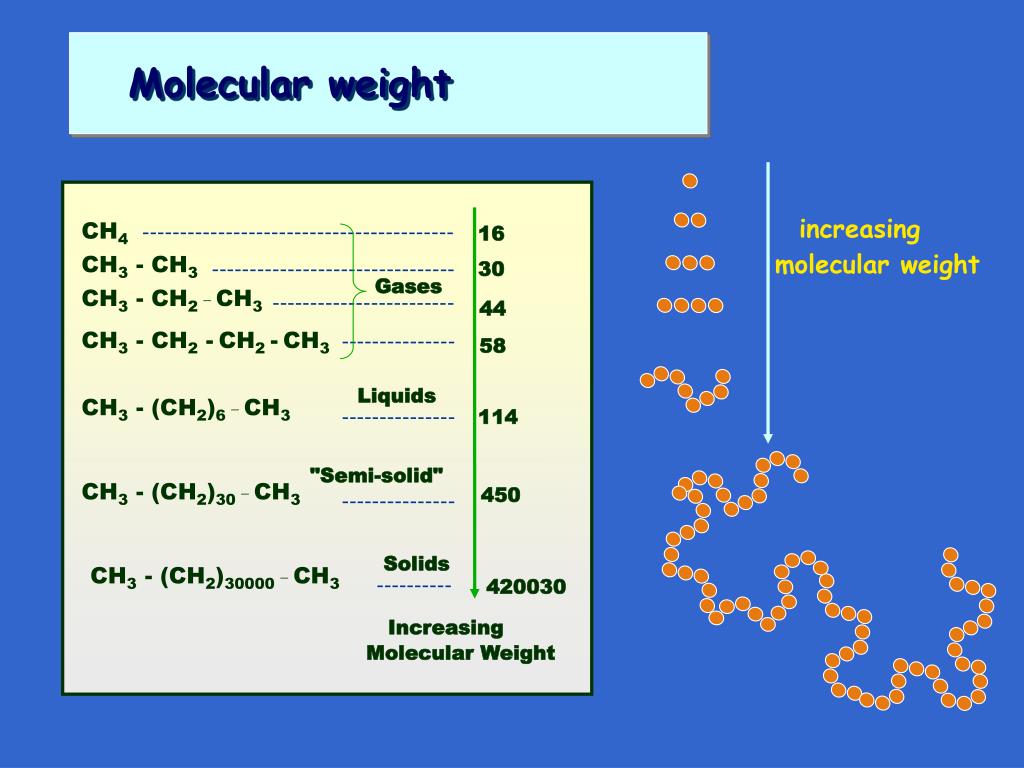
Molecular weight. CH 4. -----------------------------------------. 16. CH 3 - CH 3. --------------------------------. 30. Gases. CH 3 - CH 2 _ CH 3. ------------------------. 44. CH 3 - CH 2 - CH 2 - CH 3. ---------------. 58. Liquids. CH 3 - (CH 2 ) 6 _ CH 3.
Molecular weight - slide 1
01 / 23Molecular weight
1 / 17

Télécharger la présentation

Molecular weight
Une image / un lien ci-dessous est fourni (tel quel) pour télécharger la présentation

Politique de téléchargement : le contenu du site vous est fourni TEL QUEL pour votre information et votre usage personnel ; il ne peut être vendu, concédé sous licence ni partagé sur d’autres sites sans l’accord de son auteur.Le contenu vous est fourni TEL QUEL, pour votre information et votre usage personnel uniquement. Téléchargez la présentation en cliquant sur ce lien. Lors du téléchargement, si vous ne parvenez pas à télécharger une présentation, l’éditeur a peut-être supprimé le fichier de son serveur.Pendant le téléchargement, si vous ne parvenez pas à obtenir une présentation, le fichier a peut-être été supprimé par l’éditeur.

F I N

Plus de contenu associé

Transcription de la présentation
  1. Molecular weight CH4 ----------------------------------------- 16 CH3 - CH3 -------------------------------- 30 Gases CH3 - CH2 _ CH3 ------------------------ 44 CH3 - CH2 -CH2 -CH3 --------------- 58 Liquids CH3 - (CH2)6 _ CH3 --------------- 114 "Semi-solid" CH3 - (CH2)30 _ CH3 --------------- 450 Solids CH3 - (CH2)30000 _ CH3 ---------- 420030 Increasing Molecular Weight increasing molecular weight

  2. Molecular weight Chains have different molecular weights There is a distribution

  3. Molecular weight Tensile Strength Melt Viscosity Mol. Wt. Mol. Wt. Is it important?

  4. Molecular weight Is it important? Very important in processing If viscosity too high, polymer difficult to process If too low, an extruded material won't hold together until it solidifies

  5. Blow molding Step 1: make preform by extrusion or injection molding

  6. Blow molding Step 1: make preform by extrusion or injection molding Step 2: use air pressure to inflate preform inside closed, hollow mold. Polymer expands to take shape of cooled mold & solidifies under pressure

  7. Polymers are different

  8. Polymers are different • Normal crystalline materials • Either crystalline (~100%, neglecting defects) or amorphous at a particular temperature • Melt at a sharp, well-defined temperature • Crystallizable polymers • Never 100% crystalline • Melt over a range of temperatures

  9. Chain folding - polyethylene

  10. Or maybe this So crystalline region looks like this

  11. Image of spherulites in polarized light microscope In many polymers, crystalline regions grow to form spherulites

  12. Get alignment of crystalline regions Pull thin polymer rod in tension

  13. One way to make fibers - extrude viscous melt through tiny holes in "spinneret" Polymer fibers have aligned crystalline regions

  14. Kevlar is highly aligned Polymer fibers have aligned crystalline regions - alignment gives greater strength to fiber

  15. Breaking strength of polymer fibers (tenacity) measure denier (wt. in grams of 9000 meters of fiber) run tensile test

  16. Tenacity also increases w/ chain length - fewer crystal defects

  17. Molecular wt. Glass transition temperature (Tg)

  18. Glass transition temperature (Tg) Chemical structure

  19. Glass transition temperature (Tg) Chain stiffness

  20. Glass transition temperature (Tg) Chain stiffness

  21. Glass transition temperature (Tg) Bulky side groups