Introduction to Biology
150 likes | 277 Vues
This section introduces biology as the study of life, defined by characteristics unique to living organisms. It discusses the essential traits that classify entities as living, including cellular makeup, reproduction, genetic coding, metabolism, and response to environmental stimuli. Additionally, it outlines the scientific method—a systematic approach to problem-solving involving hypothesis development, experimentation, and observation analysis. Key concepts like control groups and variable types are explained through a practical example of a plant growth experiment with fertilizer.


Introduction to Biology
E N D
Presentation Transcript
Introduction to Biology Ch. 1 pgs. 16-22
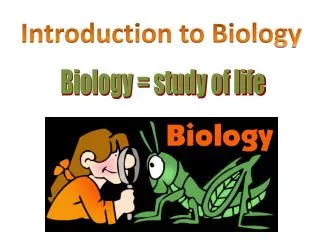
What is Biology • Bio- the Greek word bios means life • -ology- means the study of ….so Biology is the study of life!!!!
What makes something living? • In your rows work together to develop a list at least 3 of living things. • Once you come up with a list of living things develop a list of the characteristics define them as living. • Pick the 5 best characteristics and we will develop a class list of the characteristics of living things.
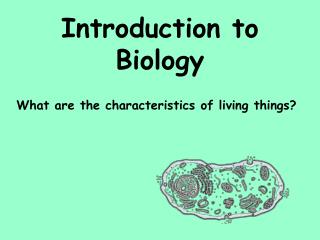
Characteristics of Living Things • All living things are made up of units called cells. • Can be unicellular or multicellular • Reproduce • Can be asexual or sexual • Based on a universal genetic code • Grow and develop • Obtain and use materials and energy • Go through a process called metabolism to break down food for energy.
Characteristics of living things • Respond to their environment • Use senses to respond to stimulus from the environment. • Maintain an internal balance • Use the process of homeostasis to maintain the balance using internal feedback mechanisms. • Ex- temperature control- what do you do when you get too cold? Too hot? • Living things change or evolve over time
What is the ScientificMethod? • It is the steps someone takes to identify a question, develop a hypothesis, design and carry out steps or procedures to test the hypothesis, and document observations and findings to share with someone else. • In other words, it’s a way to solve a problem.
The steps of the Scientific Method are: • State the Problem • Research/Gather Info. • Form a Hypothesis • Perform an Experiment • Gather Data/Info. • Analyze Data/Observations • Form a Conclusion
Control Group • The group to which no changes are made. The control group is the standard to compare all the others to. • A controlled experiment has a control group!
Independent Variable(Manipulated Variable) • The variable that you, as the experimenter, changes. You have control over this variable.
Dependent Variable(Responding Variable) • The variable that the experimenter has no control or power over.
Example: • We are going to run an experiment to see the effect that fertilizer has on the height of plants. We measure the heights of 4 plants over a month.
In the first plant we add 10 grams of fertilizer. • In the second plant, we add 20 grams of fertilizer. • In the third plant, we add 30 grams of fertilizer. • We add none to the fourth.
Questions: • Which plant was the control group? • The fourth plant, because no fertilizer was added.
What was the independent variable? • The amount of fertilizer because you changed the amount added.
What was the dependent variable? • The amount the plant grew, because you have no control over that!