Advancements in Wireless Communication and Mobility Management
140 likes | 256 Vues
This course explores the intricacies of wireless communication technology, with a focus on mobility. Learn about the definition of mobility in devices and users, and how it impacts network access across different platforms. Key topics include the evolution of communication protocols, the significance of advanced wireless technologies such as MIMO and OFDM, and the challenges posed by mobility on network performance and security. The curriculum also covers crucial areas like network management, location-based services, and multimedia applications in mobile environments.


Advancements in Wireless Communication and Mobility Management
E N D
Presentation Transcript
Mobile /Wireless CommunicationWhat can change for Mobility? Spring 2008 Instructor: Yuhao Wang
What is Mobility? • A device that moves • Between different geographical locations • Between different networks • A person who moves • Between different geographical locations • Between different networks • Between different communication devices • Between different applications
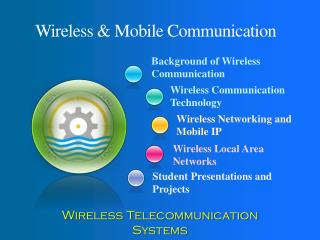
Topics in Wireless Communication • Wireless Communications • Space-time, OFDM, MIMO • UWB and Impulse Radio • Channel Modeling and Characterization • Modulation/Coding/Signal Processing • B3G Systems, WiMAX and WLAN • Advances in Wireless Video • RFID Technologies • Mobility and Handoff Management
Topics in Wireless Communication • Services and Application • Wireless/mobile networked Applications • Multimedia in Wireless Ad-hoc Networks • Authentication, Authorization and Billing • Advances in Wireless Video • Location Based Services (LBS) • Applications and Services for B3G/4G era • Radio Resource Management
Topics in Wireless Communication • Networking and Systems • Wireless sensors networking • Security in wireless networks • Network measurement and Management • Ad hoc and sensor networks • Multimedia QoS and traffic Management • Network protocols for Mobile Networks • Internetworking of WLAN & Cellular Networks
Device mobility • Plug in laptop at home/work on Ethernet • Occasional long breaks in network access • Wired network access only (connected => well-connected) • Network address changes • Only one type of network interface • May want access to information when no network is available: hoard information locally • Cell phone with access to cellular network • Continuous connectivity • Phone # remains the same (high-level network address) • Network performance may vary from place to place
Device mobility, continued • Can we achieve best of both worlds? • Continuous connectivity of wireless access • Performance of better networks when available • Laptop moves between Ethernet and Wireless LAN • Wired and wireless network access • Potentially continuous connectivity, but may be breaks in service • Network address changes • Radically different network performance on different networks
People mobility • Phone available at home or at work • Multiple phone numbers to reach me • Breaks in my reachability when I’m not in • Cell phone • Only one number to reach me • Continuously reachable • Sometimes poor quality and expensive connectivity • Cell phone, networked PDA, etc. • Multiple numbers/addresses for best quality connection • Continuous reachability • Best choice of address may depend on sender’s device or message content
Mobility means changes How does it affect the following? • Hardware • Lighter • More robust • Lower power • Wireless communication • Can’t tune for stationary access • Network protocols • Name changes • Delay changes • Error rate changes
Changes, continued • Fidelity • High fidelity may not be possible • Data consistency • Strong consistency no longer possible • Location/transparency awareness • Transparency not always desirable • Names/addresses • Names of endpoints may change • Security • Lighter-weight algorithms • Endpoint authentication harder • Devices more vulnerable
Changes, continued, again • Performance • Network, CPU all constrained • Delay and delay variability • Operating systems • New resources to track and manage: energy • Applications • Name changes • Changes in connectivity • Changes in quality of resources • People • Introduces new complexities, failures, devices
Example changes • Addresses • Phone numbers, IP addresses • Network performance • Bandwidth, delay, bit error rates, cost, connectivity • Network interfaces • PPP, eth0, strip • Between applications • Different interfaces over phone & laptop • Within applications • Loss of bandwidth triggers change from B&W to color • Available resources • Files, printers, displays, power, even routing
Summing up Generally, mobility stresses all resources further: • CPU • Power • Bandwidth • Delay tolerance • Radio spectrum • Human attention • Physical size • Constraints on peripherals and GUIs (modality of interaction) • Locations (body parts!) for device placement
References • T. S. Rappaport, "Wireless Communications: Principles & Practice," 2nd Ed., Prentice-Hall:Upper Saddle River, NJ, 2002, ISBN 0-13-042232-0. • Jon Mark, Weihua Zhuang, "Wireless Communications and Networking," Prentice Hall. ISBN: 0130409057; 2003. • David Tse, Pramod Viswanath, "Fundamentals of Wireless Communications," Cambridge University Press, 2005. • Harri Holma and Antti Toskala (ed.), ``WCDMA for UMTS : radio access for third generation mobile communications,'' Chichester ; New York : Wiley, c2000. • John G. Proakis, ``Digital communications,'' 4th ed., Boston : McGraw-Hill, c2001. • . D. Parsons, "The Mobile Radio Propagation Channel," 2nd Edition, Wiley, 2000. • G. L. Stueber, ``Principles of mobile communication,'' 2nd Ed., Norwell, MA: Kluwer, 2001. • http://www.wu.ece.ufl.edu/books/EE/wireless/wireless.html