Innovative Shared Rainwater Harvesting System for Ddegeya, Uganda
In Ddegeya, Uganda, residents rely on contaminated water sources, spending hours each day collecting water. To alleviate this issue, a novel shared rainwater harvesting system has been introduced, combining household and community-scale benefits. This affordable and accessible solution features a centrally located tank shared by multiple households, fostering community ownership and responsibility for maintenance. Prototyped with community input, five tanks were constructed in 2012, offering a resilient solution to provide safe water, reduce school absenteeism, and combat common diseases.

Innovative Shared Rainwater Harvesting System for Ddegeya, Uganda
E N D
Presentation Transcript
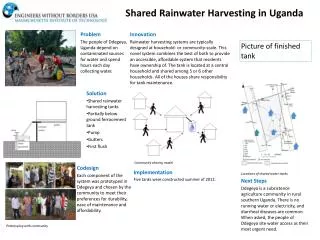
Shared Rainwater Harvesting in Uganda Problem The people of Ddegeya, Uganda depend on contaminated sources for water and spend hours each day collecting water. Innovation Rainwater harvesting systems are typically designed at household- or community-scale. This novel system combines the best of both to provide an accessible, affordable system that residents have ownership of. The tank is located at a central household and shared among 5 or 6 other households. All of the houses share responsibility for tank maintenance. N Picture of finished tank • Solution • Shared rainwater harvesting tanks • Partially below ground ferrocement tank • Pump • Gutters • First flush Children miss school to collect water. Community sharing model Codesign Each component of the system was prototyped in Ddegeya and chosen by the community to meet their preferences for durability, ease of maintenance and affordability. Implementation Five tanks were constructed summer of 2012. System design Locations of shared water tanks. Next Steps Ddegeya is a subsistence agriculture community in rural southern Uganda. There is no running water or electricity, and diarrheal diseases are common. When asked, the people of Ddegeya site water access as their most urgent need. Prototyping with community