The LHC Upgrade. 2007 CERN Summer Student Lectures Albert De Roeck CERN. SLHC. Contents of this Lecture. Introduction & LHC history The LHC upgrade path Implications for the LHC detectors The physics case for the upgrade by examples Summary of this lecture.
Une image / un lien ci-dessous est fourni (tel quel) pour télécharger la présentation
Politique de téléchargement : le contenu du site vous est fourni TEL QUEL pour votre information et votre usage personnel ; il ne peut être vendu, concédé sous licence ni partagé sur d’autres sites sans l’accord de son auteur.Le contenu vous est fourni TEL QUEL, pour votre information et votre usage personnel uniquement.Téléchargez la présentation en cliquant sur ce lien.Lors du téléchargement, si vous ne parvenez pas à télécharger une présentation, l’éditeur a peut-être supprimé le fichier de son serveur.Pendant le téléchargement, si vous ne parvenez pas à obtenir une présentation, le fichier a peut-être été supprimé par l’éditeur.
F I N
Plus de contenu associé
Transcription de la présentation
The LHC Upgrade 2007 CERN Summer Student Lectures Albert De Roeck CERN SLHC
Contents of this Lecture • Introduction & LHC history • The LHC upgrade path • Implications for the LHC detectors • The physics case for the upgrade by examples • Summary of this lecture Some slides taken from S. Tapprogge/EPS-ECFA talk
j1 W j2 t b-jet Physics at the LHC: pp @ 14 TeV Extra Dimensions? Black Holes??? Higgs! Supersymmetry? QGP? Unitarity triangle! Precision measurements e.g top! The LHC will be the new collider energy frontier
The LHC: 23 Years Already! 1984 /LHC 1984: cms energy 10-18 TeV Luminosity 1031-1033cm-2s-1 1987: cms energy 16 TeV Luminosity 1033-1034cm-2s-1 Final: cms energy 14 TeV Luminosity 1033-1034cm-2s-1
Ramping up the LHC hypothetical luminosity scenario J. Strait 2003: Not an “official” LHC plot Statistical error1/N error error/2 N N.4 Constant luminosity/year 1 year4 years16 years Luminosity= #events/cross-section/time If startup is as optimistic as assumed here (1034 cm-2s-1 in 2011 already) After ~3-4 years (~300 fb-1) a simple continuation becomes less exciting Time for an upgrade around 2015?
The LHC upgrade: SLHC Already time to think of upgrading the machine if wanted in ~10 years Two options presently discussed/studied • Higher luminosity ~1035cm-2 s-1 (SLHC = 10 x LHC) • Needs changes in machine and and particularly in the detectors • Start change to SLHC mode some time 2014-2016 • Collect ~3000 fb-1/experiment in 3-4 years data taking. • Discussed in this lecture • Higher energy? (DLHC) • LHC can reach s = 15 TeV with present magnets (9T field) • s of 28 (25) TeV needs ~17 (15) T magnets R&D needed! • Even some ideas on increasing the energy by factor 3 (P. McIntyre)
Possible Machine Scenarios Early Separation (ES) of the beams • Ultimate beam • Stronger focusing • Early separating dipoles • Crab cavities • New magnets deep inside the detector • Crab cavities for hadron beams • Poor beam and luminosity lifetime Large Piwinski Angle (LPA) • Double bunch spacing • More intense bunches • Wire compensating to correct beams • High bunch charge/beam current • Operate with large Piwinski angle • Wire compensation (to be tested)
Electron Cloud Effect • Electrons from gas molecules, ionized by the proton bunch & synchrotron radiation. • Once released, electrons get accelerated to 100-1000 eV and hit the wall surface heating Can be preventive to run with to short bunch spacing Will learn from LHC operation
Example of Detector Upgrades Tracker detector of both CMS & ATLAS will need to be replaced Occupancy, radiation Include the tracker in the L1 trigger? • Study, detector R&D and production takes time! • Possible scenario: Proceed in two steps • Include new layers in the present tracker during the LHC running • Upgrade to full new tracker system by SLHC (8-10 years from LHC Startup) ATLAS & CMS upgrade workshops since ~two years ..
Tracker Upgrade Academic training lectures http://agenda.cern.ch/fullAgenda.php?ida=a056409
Physics Case for the SLHC • LHC should have told us, say, by 2010 (with ~10-30 fb-1) • Whether a light (or heavy) Higgs exist ..unveil the EWSB mechanism • Whether the world is or could be (low energy) supersymmetric • Whether we can produce dark matter in the lab • Whether there are more space time dimensions, micro-black holes… • Whether it is all different than what we thought • Whether there is nothing strikingly new found in its reach…unlikely! • Either at least one Higgs exisits with mass below 1 TeV, or new • phenomena (strong EWSB?) set on in the TeV region • New physics prefers the TeV scale (Hierarchy problem, fine tunning) but not fully guaranteed • The use/need for the SLHC will obviously depend on how EWSB • and/or the new physics will manifest itself at the LHC See K. Jacob’s Lectures
Extending the Physics Potential of LHC • Electroweak Physics • Production of multiple gauge bosons (nV 3) • triple and quartic gauge boson couplings • Top quarks/rare decays • Higgs physics • Rare decay modes • Higgs couplings to fermions and bosons • Higgs self-couplings • Heavy Higgs bosons of the MSSM • Supersymmetry • Extra Dimensions • Direct graviton production in ADD models • Resonance production in Randall-Sundrum models TeV-1 scale models • Black Hole production • Quark substructure • Strongly-coupled vector boson system • WLZL g WLZL , ZLZL scalar resonance, W+LW +L • New Gauge Bosons Examples studied in some detail Include pile up, detector… hep-ph/0204087
W W g, Z Standard Model Physics • Precision measurements of Standard Model processes and parameters • Deviations of expectations can point to new physics or help to understand new observed phenomena Triple Gauge Couplings Top quark Lectures of A Pich
W W g, Z Standard Model Physics • Precision measurements of Standard Model processes and parameters • Deviations of expectations can point to new physics or help to understand new observed phenomena TGCs Rare top decays Higgs …
W W g, Z Triple/Quartic Gauge Couplings Triple gauge couplings: W,WZ production Production of multiple gauge bosons: statistics limited at LHC E.g. # events with full leptonic decays, Pt>20 GeV/c, ||<2.5, 90% eff for 6000 fb-1 Typically gain of a factor of 2 in precision with SLHC
Top Quark Properties SLHC statistics can still help for rare decays searches Results in units of 10-5 Ideal = MC 4-vector Real = B-tagging/cuts as for 1034cm-2s-1 -tag = assume only B-tag with muons works at 1035cm-2s-1 tq tqZ Can reach sensitivity down to ~10-6 BUT vertex b-tag a must at 1035cm-2s-1
Higgs Physics What is the origin of Electro-weak Symmetry Breaking? If Higgs field at least one new scalar particle should exist: The Higgs One of the main missions of LHC: discover the Higgs for mH< 1 TeV Higgs Brout, Englert No Higgs particle seen so far: 114 GeV (LEP) <MHiggs< 1 TeV (Theory)
Example: The Higgs at the LHC • First step • Discover a new Higgs-like particle at the LHC, or exclude its existence • Second step • Measure properties of the new particle to prove it is the Higgs • Measure the Higgs mass • Measure the Higgs width • Measure cross sections x branching ratios • Ratios of couplings to particles (~mparticle) • Measure decays with low Branching ratios (e.g H) • Measure CP and spin quantum numbers (scalar particle?) • Measure the Higgs self-coupling (HHH), in order to reconstruct the Higgs potential LHC~1 good year of data SLHC added value Only then we can be sure it is the Higgs particle we were looking for
gHff Channel mH S/B LHC S/B SLHC (600 fb-1) (6000 fb-1) H Z ~ 140 GeV ~ 3.5 ~ 11 H 130 GeV ~ 3.5 (gg+VBF) ~ 9.5 (gg) Higgs Decays Modes Rare Higgs Decays gH/gH? Channels studied: H Z H Branching ratio ~ 10-4 for these channels! Cross section ~ few fb Higgs Couplings (ratios) Can be improved with a factor of 2: 20%10% at SLHC
~ v mH2 = 2 v2 Higgs Self Coupling Measurements Once the Higgs particle is found, try to reconstruct the Higgs potential Djouadi et al. Dawson et al. /2 << 3/2 Difficult/impossible at the LHC
Higgs Self Coupling Baur, Plehn, Rainwater HH W+ W- W+ W- jj jj Limits achievable at the 95% CL. for =(-SM)/SM LHC: = 0 can be excluded at 95% CL. SLHC: can be determined to 20-30% (95% CL) Note: Different conclusion from ATLAS study no sensitivity at LHC and smaller sensitivity at SLHC. Jury is still out
q q VL VL VL q VL q Strongly Coupled Vector Boson System If no Higgs, expect strong VLVL scattering (resonant or non-resonant) at • Could well be Difficult at LHC. What about SLHC? • degradation of fwd jet tag and central jet veto due to huge pile-up • BUT : factor ~ 10 in statistics 5-8 excess in W+L W+L scattering • other low-rate channels accessible
Beyond the Standard Model New physics expected around the TeV scale Stabelize Higgs mass, Hierarchy problem, Unification of gauge couplings, CDM,… Supersymmetry Extra dimensions +… + a lot of other ideas… Split SUSY, Little Higgs models, new gauge bosons, technicolor, compositness,.. Lectures by E Kiritsis
Supersymmetry • Supersymmetry (SUSY) assumes a new hidden symmetry between the bosons (particles with integer spin) and fermions (particles with half integer spin). Stabelize the Higgs mass up to the Planck scale • Lots of new particles (squarks, sleptons,…) predicted with masses in the range from 10’s of GeV’s up to several TeV range Lightest SUSY particle stable: dark matter candidate ?
Supersymmetry A VERY popular scenario for new physics… "One day, all of these will be supersymmetric phenomenology papers." More than 7000 papers since 1990
Supersymmetry SUSY could be at the rendez-vous very early on! 10fb-1 Therefore: SUSY one of the priorities of the “search” program Main signal: lots of activity (jets, leptons, taus, missing ET) Needs however good understanding of the detector & SM processes!!
5 contours CMS tan=10 Supersymmetry Impact of the SLHC Extending the discovery region by roughly 0.5 TeV i.e. from ~2.5 TeV 3 TeV This extension involved high ET jets/leptons and missing ET Not compromised by increased pile-up at SLHC Usually minimal Supergravity (mSUGRA) taken for studies 5 parameters m1/2: universal gaugino mass at GUT scale m0: universal scalar mass at GUT scale tan: vev ratio for 2 Higgs doublets sign(): sign of Higgs mixing parameter A0: trilinear coupling
SLHC: tackle difficult SUSY scenarios Squarks: 2.0-2.4 TeV Gluino: 2.5 TeV Can discover the squarks at the LHC but cannot really study them Pt >700 GeV & Etmiss>600 GeV Pt of the hardest jet eg. Point K in hep-ph/0306219 signal Exclusive channel qq 10 10 qq S/B =120/30 (3000fb-1) Higgs in 2 decay 21h becomes Visible at 3000 fb-1 Inclusive: Meff> 4000 GeV S/B = 500/100 (3000 fb-1) ~~ Measurements of some difficult scenarios become possible at the SLHC
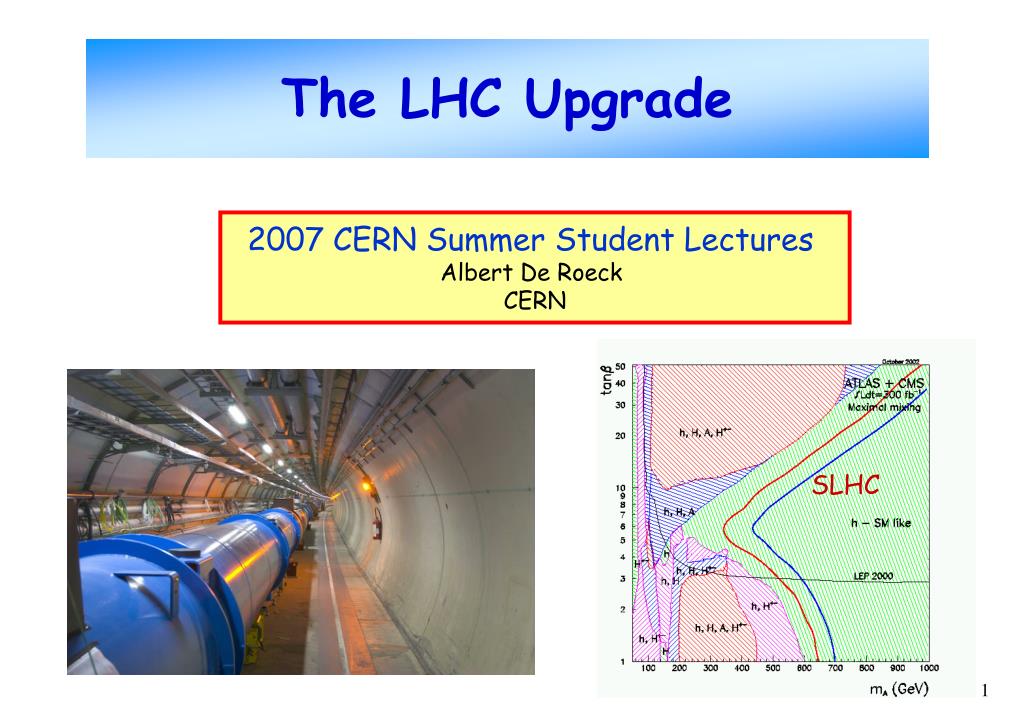
SUSY Higgses h,H,A,H • Minimal supersymmetric model • Introduces two complex higgs doublets • 5 Higgs particles h,H,A,H • H = CP even/ A = CP odd In the green region only SM-like h observable with 300 fb-1/exp Red line: extension with 3000 fb-1/exp Blue line: 95% excl. with 3000 fb-1/exp Heavy Higgs observable regionincreased by ~100 GeV at the SLHC.
Extra Dimension Signals at the LHC example Graviton production! Graviton escapes detection Large (ADD) type of Extra Dimensions Signal: single jet + large missing ET escape! About 25% increase in reach
Z’@6TeV ADD X-dim@9TeV SUSY@3TeV 3000 Compositeness@40TeV H(120GeV)gg 300 Higgs@200GeV SUSY@1TeV 30 SHUTDOWN 200 fb-1/yr 10-20 fb-1/yr 100 fb-1/yr 1000 fb-1/yr F. Moortgat, A. De Roeck First physics run: O(1fb-1) LHC Luminosity/Sensitivity Evolution? SLHC
Indicative physics results Approximate mass reach machines: s = 14 TeV, L=1034 (LHC) : up to 6.5 TeV s = 14 TeV, L=1035 (SLHC) : up to 8 TeV s = 28 TeV, L=1034 (DLHC) : up to 10 TeV Ellis, Gianotti, ADR hep-ex/0112004+ few updates
Summary: LHC Upgrade The LHC luminosity upgrade to 1035 cm-2s-1 In general: SLHC gives a good physics return for modest cost, basically independent of the physics scenario chosen by Nature It is a natural upgrade of the LHC Extend the LHC discovery mass range by 25-30% (SUSY,Z’,EDs,…) Higgs self-coupling measurable with a precision of (20-30%) Rear decays accessible: H, Z, top decays… Improved Higgs coupling ratios by a factor of 2,… TGC precision measurements… • It will be a challenge for the experiments! • Needs detector R&D starting now: Tracking, electronics, trigger, endcaps, radiation, shielding… • CMS and ATLAS started working groups The energy upgrade DLHC is certainly more costly and up in the future
DkZ Z Z Electroweak Physics Triple gauge couplings: sensitivity 14 TeV 100 fb-1 14 TeV 1000 fb-1 28 TeV 100 fb-1 28 TeV 1000 fb-1 Sensitivity into the range expected from radiative corrections in the SM
SLHC: New Z’ Gauge Bosons with Z-like couplings S. Godfrey Includes pile-up, ECAL saturation… Reach: LHC/600 fb-1 5.3 TeV SLHC/6000 fb-1 6.5 TeV DLHC/600 fb-1 8 TeV
: contact interactions qq qq mjj > 11 TeV Deviation from SM 95% CL14 TeV 300 fb-114 TeV 3000 fb-128 TeV 300 fb-128 TeV 3000 fb-1 (TeV) 40 60 60 85 28 TeV 3000 fb-1 Compositeness 2-jet events: expect excess of high-ET centrally produced jets. * angle btw jet & beam If contact interactions excess at low For this study, no major detector upgrade needed at SLHC (but b-jet tag may be important)
Electroweak Physics Quartic Gauge Couplings study pp qqVV jjVV (V=W,Z) A. S. Belyaev et al: Operators leading to genuine quartic vertices Usually minimal Supergravity (mSUGRA) taken for studies 5 parameters m1/2: universal gaugino mass at GUT scale m0: universal scalar mass at GUT scale tan: vev ratio for 2 Higgs doublets sign(): sign of Higgs mixing parameter A0: trilinear coupling Results for events with full leptonic decays, Pt>20 GeV/c, ||<2.5, 90% eff. (conservative)
SLHC: tackle difficult points eg. Point H in hep-ph/0306219 pT of stau Squarks, gluino mass > 2.5 TeV -stau mass difference small < 1 GeV Stau lives long Dilepton mass End point measurements are possible with large luminosity Without stau detection With stau detection
SLHC: KK gravitons Randall Sundrum model Predicts KK graviton resonances k= curvature of the 5-dim. Space m1 = mass of the first KK state TeV scale ED’s KK excitations of the ,Z T.Rizzo SLHC 95% excl. limits Direct: LHC/600 fb-1 6 TeV SLHC/6000 fb-1 7.7 TeV Interf:SLHC/6000 fb-1 20 TeV 1001000 fb-1:Increase in reach by 25%
Connexion au compte
Connectez-vous pour publier votre contenu sur SlideServe.