Download
1 / 14
140 likes | 266 Vues
This review covers essential concepts of function notation, including the evaluation of functions and operations such as sum, difference, product, quotient, and composition. Example problems demonstrate how to find values like f(2) and f(a+1), illustrating substitution and evaluations. It highlights the significance of function composition, which involves substituting one function into another. This comprehensive guide aims to clarify the mechanics of basic function operations and composition, essential for mastering algebraic concepts.

E N D
Review • Function notation: f(x) • This DOES NOT MEAN MULITPLICATION. • Given f(x) = 3x - 1, find f(2). • Substitute 2 for x • f(2) = 3(2) - 1 = 6 - 1 = 5
Review • Given f(x) = x - 5, find f(a+1) • f(a + 1) = (a + 1) - 5 = a+1 - 5 • f(a + 1) = a - 4
Objectives • To define the sum, difference, product, and quotient of functions. • To form and evaluate composite functions.
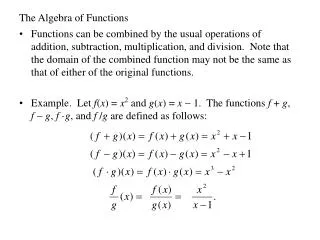
Basic function operations • Sum • Difference • Product • Quotient
Function operations • If and find:
Function operations • If and find:
Function operations • If and find:
Function operations • If and find:
Function Composition • Function Composition is just fancy substitution, very similar to what we have been doing with finding the value of a function. • The difference is we will be plugging in another function
Function Composition • Just the same we will still be replacing x with whatever we have in the parentheses. • The notation looks like • We read it ‘f of g of x’
Composition of functions • Composition of functions is the successive application of the functions in a specific order. • Given two functions f and g, the composite functionis defined by and is read “f of g of x.”
x f Function Machine Function Machine g A different way to look at it…