Neurotransmitters in the Nervous System
Learn about neurotransmitter synthesis, classification, and receptors in the nervous system. Explore how these chemical substances affect target tissues through various mechanisms of action.

Neurotransmitters in the Nervous System
E N D
Presentation Transcript
Neurotransmitters Bibi Kulsoom
Nervous System http://archive.ck12.org/ck12/images?id=334457
Neuron http://springvisualculture1b.blogspot.com/2010/04/neuron-psychologist.html
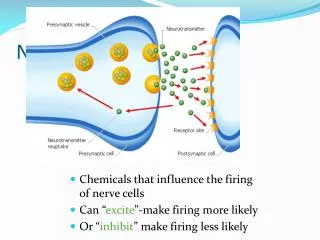
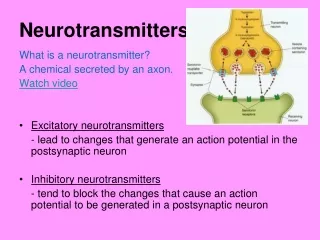
Neurotransmitter A chemical substance that is • Synthesized in a neuron. • Stored in presynaptic nerve terminal. • Released into synaptic cleft. • Act upon the postsynaptic neuron, muscle or organ. Synthesis of neurotransmitter Axon of a neuron Stored neurotransmitter Presynaptic membrane Axon terminal Postsynaptic membrane Synaptic cleft Postsynaptic membrane receptors Effect specific to target tissue
Acetylcholine • Synthesized from acetyl CoA and choline. • Stored in presynaptic terminal • Released into synaptic cleft • Act upon the postsynaptic receptors • Receptors are two types • Muscarinic, 2.Nicotinic • Acetylcholine esterase hydrolyzes acetylcholine. Acetyl CoA + Choline Acetylcholine esterase Muscarinic 2.Nicotinic Effect specific to target tissue
Types of Cholinergic Receptors Muscarinic Nicotinic Acetylcholine Acetylcholine http://www.nature.com/npp/journal/v37/n1/images/npp2011199f2.jpg
Distribution of Cholinergic Receptors Peripheral Nervous System CNS Nic Nic Nic ACh ACh Muscarinic Parasympathetic ACh Nictinic: Adrenal medulla Sympathetic ACh NE Adrenergic: Heart and blood vessels ACh ACh Muscarinic: Sweat glands Nicotinic: Skeletal muscles ACh Somatic
Myasthenia Gravis http://jama.ama-assn.org/content/vol293/issue15/images/medium/jpg0420f1.jpg
2 H H 2 Catecholamines Epinephrine Catecholaminesare derivatives of tyrosine & contain a catechol (dihydroxybenzene) ring. The difference between epinephrine and norepinephrine: one additional methyl group in structure of epinephrine. The difference between norepinephrine and dopamine: one additional hydroxyl group in the structure of norepinephrine. (Adrenaline) Norepinephrine (Noradrenaline) Dopamine kulsoom http://website.lineone.net/~dave.cushman/epipen.html
Sympathetic System Sympathetic Nervous System: Postganglionic nerve fibers Preganglionic nerve fibers Thoracolumber ACh Noradrenaline Target tissue Ganglion Vasodilation Blood Adrenal Medulla: Skeletal muscle Adrenaline Thoracic ACh Noradrenaline Digestive system Adrenal Medulla Vasoconstriction kulsoom
Synthesis of Adrenaline and Noradrenaline Adrenal Medulla Synthesis of Adrenaline & Noradrenaline Synthesis of Adrenaline & Noradrenaline Phenylalanine Hydroxylase Sympathetic Nerve Tyrosine Hydroxylase DOPA decarboxylase Dopamine Hydroxylase Phenylethanolamine N-Methyltransferase Effect specific to target tissue
Mechanism of Action http://www.sp.uconn.edu/~bi107vc/images/anim/SigtranRA.gif
Adrenergic Receptor Beta Alpha kulsoom Alpha 1 Alpha 2 Beta 1 Beta 2 Beta 3 Adrenergic receptors are seven-pass transmembrane proteins. kulsoom
Mechanism of Action • These are called G protein-coupled receptors (GPCRs). • The three subunits are: Gα, Gβ, Gγ • Gα carries the binding site for the nucleotide and is different in different types of G proteins Gs, Gi and Gq. Gα β β Giα Gsα Gqα • Gβ and Gγ are same in all types of G proteins. http://withfriendship.com/images/c/14666/Adrenergic-receptor-wallpaper.gif
= Adrenaline & Noradrenaline 1 2 Gq Gs Gi Phospholipace C Adenylate cyclase Adenylate cyclase DAG PIP2 cAMP cAMP IP3 Decreased Increased Decreased Increased Ca2+ Ca2+ Inhibition of neurotransmitter release from neuron • Glycogen breakdown • Smooth muscle relaxes • Cardiac muscle contracts Smooth muscle Contraction Smooth muscle Contraction Effector cell kulsoom = leading to = inhibits
Effect of Autonomic NS on Heart Parasympathetic Nerves (Vagus) Sympathetic Nerves & Norepinephrine ACh NE 1 2 M2 ↑ heart rate ↑ conduction velocity ↑contractility ↑ rate of myocyte relaxation _ + Cardiomyocyte http://www.cvphysiology.com/Blood%20Pressure/BP010.htm Kulsoom animated from http://www.cvphysiology.com/Blood%20Pressure/BP010.htm http://bioserv.fiu.edu/~walterm/fund_sp2004/heart/f12-20_baroreceptor_and_c.jpg
Distribution of Adrenergic Receptor E = Epinephrine At low epinephrine concentrations, the beta-2 adrenergic receptors will be occupied because these receptors have a higher affinity for epinephrine. At high epinephrine concentrations, the alpha-1 adrenergic receptors will be occupied too. Because there are more alpha-1 receptors the predominant effect at high epinephrine concentration is vascular smooth muscle contraction. kulsoom
Dopamine http://it.wikipedia.org/wiki/File:Dopamine_chemical_structure.png
Glycine NMDA=N-methyl-D-aspartate http://o.quizlet.com/i/I8RJX-RlIpAe58vmHdpL0w_m.jpg
Aspartic Acid L-Aspartate NMDA=N-methyl-D-aspartate http://0.tqn.com/d/chemistry/1/7/V/V/1/L-aspartic_acid.png
Glutamate Glutamate AMPA = amino-methyl propanoic acid
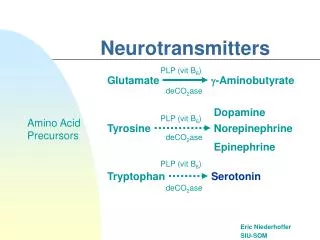
-aminobutyric acid (GABA) CO2 Synthesis: Glutamate decarboxylase -aminobutyric acid (GABA) Glutamate
Serotonin Synthesis: Hydroxylation & decarboxylation Serotonin (5-hydroxytryptamine) Tryptophan http://www.wormatlas.org/neurotransmitterstable.htm
Histamine Histidine Histamine http://web.campbell.edu/faculty/nemecz/323_lect/Nitrogen_metabolism/images/histamine.jpg
Neuropeptides There are around 200 neuropeptides identified.
Miscellaneous Neurotransmitters • ATP: • Is found in both the CNS and PNS • Produces excitatory or inhibitory responses depending on receptor type. • Induces Ca2+ wave propagation in astrocytes • Provokes pain sensation • Nitric oxide (NO) : • Activates the intracellular receptor guanylyl cyclase • involved in learning and memory. • Carbon monoxide (CO): • a main regulator of cGMP in the brain
Subhan Allah http://myyatradiary.blogspot.com/2011/08/treks-beyond-badrinath-swargarohini.html