
Thematic Roles in NLU
E N D
Presentation Transcript
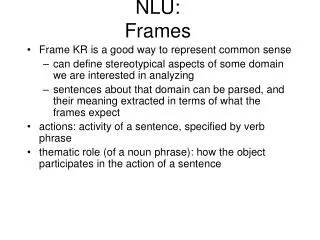
NLU: Frames • Frame KR is a good way to represent common sense • can define stereotypical aspects of some domain we are interested in analyzing • sentences about that domain can be parsed, and their meaning extracted in terms of what the frames expect • actions: activity of a sentence, specified by verb phrase • thematic role (of a noun phrase): how the object participates in the action of a sentence
sentence analysis: • what thematic roles are to be filled by a sentence • determining thematic roles of noun phrases • many theories define different thematic roles; common objective is to determine adequate constraints (logical limitations) between action and thematic roles
What are semantic roles and what is their history? • A lot of forms of traditional grammar (Sanskrit, Japanese, …) analyze in terms of a rich array of semantically potent case ending or particles • They’re kind of like semantic roles • The idea resurfaces in modern generative grammar in work of Charles (“Chuck”) Fillmore, who calls them Case Roles (Fillmore, 1968, The Case for Case). • They’re quickly renamed to other words, but various: • Semantic roles • Thematic roles • Theta roles • A predicate and its semantic roles are often taken together as an argument structure
Okay, but what are they? • An event is expressed by a predicate and various other dependents • The claim of a theory of semantic roles is that these other dependents can be usefully classified into a small set of semantically contentful classes • And that these classes are useful for explaining lots of things
Common semantic roles • Agent: initiator or doer in the event • Patient: affected entity in the event; undergoes the action • Sue killed the rat. • Theme: object in the event undergoing a change of state or location, or of which location is predicated • The ice melted • Experiencer: feels or perceive the event • Bill likes pizza. • Stimulus: the thing that is felt or perceived
Common semantic roles • Goal: • Bill ran to Copley Square. • Recipient (may or may not be distinguished from Goal): • Bill gave the book to Mary. • Benefactive (may be grouped with Recipient): • Bill cooked dinner for Mary. • Source: • Bill took a pencil from the pile. • Instrument: • Bill ate the burrito with a plastic spork. • Location: • Bill sits under the tree on Wednesdays
Common semantic roles Try for yourself! • The submarine sank a troop ship. • Doris hid the money in the flowerpot. • Emma noticed the stain. • We crossed the street. • The boys climbed the wall. • The chef cooked a great meal. • The computer pinpointed the error. • A mad bull damaged the fence on Jack’s farm. • The company wrote me a letter. • Jack opened the lock with a paper clip.
Thematic roles • Agent: the passive or active entity that causes an action • Donald kicked the ball. • Co-agent: partner with agent • Donald kicked the ball with his friend Mickey. • Thematic object: the object undergoing change, to which the action is being applied • Donald kicked the ball. • Instrument: tool used by agent • Donald kicked the ball with his foot. • Location: where action occurs • Donald kicked the ball on the field. • and others
To Whom? (Co-Agent) Who’s Giving? (Agent) Giving What? (Theme) GIVE For Whom (Beneficiary) Where? (@loc) When? (Time) Frame Based Formalism The kind mangavea breadtothe beggarforhis hungry child.
Frame based formalism (contd.) • Partial instantiation of a frame is possible. • Different verbs can have different frames. • The domain of a role is dependent on the verb. • Frame is instantiated based on the input provided by the user. • Role can be a single concept or a composition basedon qualifier-qualified structure.
Filled thematic roles • Robbie made coffee for Suzie with a percolator.
Thematic roles and parsing • In easy sentences, thematic roles are ascertainable by from grammar: • verb constrains thematic roles, and placement of noun phrases • propositions limit noun phrase role possibilities • eg. by : agent or conveyance or location • with : co-agent or instrument • to : destination • nouns may limit roles • main noun phrase determines roles of others • still lots of ambiguities: need a large lexicon! • Time flies like an arrow. • Fruit flies like a banana.
Constraints • Constraint: an enforced problem-specific limitation • the main task of NLU is to exploit contraints of grammar, phrases, thematic roles on one another to determine an overall (hopefully unambiguous) meaning • without constraints, there are too many possible meanings and thematic roles • humans can quickly ascertain the constraints of a sentence • but you can write ambiguous ones too: • I gave the celery to the rabbit and then ate it. • We can predefine word meaning, and use to establish permissible constraints • but there can be a lot! (how many meanings of “take”)
Constraints and frames • frame representations • slots: thematic roles • action frames: specify sentence action • state-change frames: resulting change of state of thematic roles that occur through action • result link: indicates change of state from an action, & points to state-change frame • meanings of sentences represented by state changes • primitive action systems: a frame system in which: • a primitive action slot is filled from a small set of actions • state change slots indicate result of primitive actions • can be used to determine what happened in sentence (explicitly and implicitly)