Download
1 / 16
170 likes | 345 Vues
This educational overview explains the different types of nouns in English, focusing on singular, plural, possessive, concrete, abstract, and proper nouns. Each category is defined clearly, with examples provided to illustrate their usage, such as "I want a teddy bear (s)" for singular nouns and "I wear braces (p)" for plural nouns. Additionally, we explore possessive nouns like "Rudolph's (poss)" and other noun types, including concrete and abstract nouns. This comprehensive guide aims to enhance your understanding of English grammar essentials.

E N D
Singular noun (s) • A noun is a thing, like a teddy bear. • It is singular if there is only one. • Write a sentence that contains a singular noun and put (s) after it. • I want a teddy bear (s).
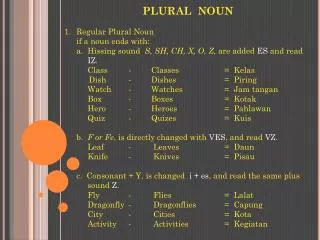
Plural noun (p) • If you have 2 or more things, the noun is plural and usually ends in s. • Write a sentence with a plural noun and put (p) after it. • I wear braces (p).
Possessive noun (poss n) • There is an ownership. • Write a sentence that has a possessive noun and put (poss n) after it. • Is Rudolph’s (poss n) nose really red?
Concrete noun (con) • Something you see, smell, taste, touch, or hear with your senses. • How fast does your sled (con) go?
Abstract noun (abst) • An idea or feeling, like love, freedom, bravery. • His pride (abst) was hurt.
Proper Noun (prop) The name of a person, place, or thing. Starts with a capital letter. • Are you going back to the North Pole (prop).
Common noun (com) • A person, place, or thing in general. • A thing that does not have to start with a capital letter. • I like shiny wheels (com).
Personal pronoun (per) • He, she, it, I, me, you, we, they, us, them • It (per) has a ribbon.
Possessive pronoun (poss p) • My, mine, your, his, hers, its, their, our • Our (poss p) house is on the left.
Reflexive pronoun (ref) • Myself, yourself, himself, ourselves, yourselves, themselves • The same person or thing is involved. • Give yourself (ref) something nice.
Intensive pronoun (ints p) • Myself, yourself, himself, ourselves, yourselves, themselves • Adds emphasis. • I wrote it myself (ints p).
Interrogative pronoun (intrr p) • who, whom, whose, what, and which. • Whoever, whatever, whichever. • Creates a question. • Who (intrr p) will help you?
Relative pronoun (rel p) • who what which that • Whoever whatever whichever whose • Starts a relative clause. • Is Rudolph the reindeer who (rel p) leads the way?
Linking verb (link) • am, is, are, was, were, will be • Rudolph is (link) my favorite reindeer.
Transitive verb (trns v) • The words after the verb answer the question what or who. • Reindeers pull (trns v) the sled.
Intransitive verb (intrs v) • The words after the verb do not answer the question what or who. • Your sled flies (intrs v) far.