Download
1 / 10
100 likes | 209 Vues
This presentation outlines seven strategic approaches utilized by Santa Clara University's WASC committees for effective institutional proposal preparation. Key strategies include assembling a trustworthy team capable of contributing to a comprehensive self-study, anticipating and addressing potential opposition, selecting engaging and practical themes, and fully integrating the CFRs into institutional practices. It emphasizes the importance of clear communication and documentation throughout the process, advocating for the development of a robust syllabus that outlines key goals and learning outcomes.

E N D
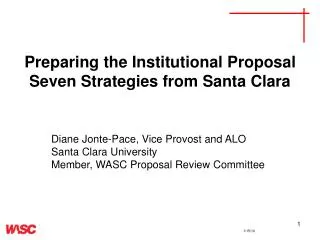
Preparing the Institutional Proposal Seven Strategies from Santa Clara Diane Jonte-Pace, Vice Provost and ALO Santa Clara University Member, WASC Proposal Review Committee 1/15/10
OverviewSeven Strategies, Three Topics • People • Targeting a trustworthy team • Anticipating antagonists • Content • Selecting a sexy theme; picking a practical theme • Learning to love the CFRs • Connecting Capacity & Effectiveness • Process • Discerning and distributing documents • Syllabi Disclaimer: This presentation outlines strategies that Santa Clara University’s WASC committees have found useful. The language and recommendations are not identical to language and recommendations in WASC’s documents.
Targeting a Trustworthy Team • Choose a team you can trust • A team that can write a “syllabus” for a four year self study • A team with responsibility & credibility • A team who will appreciate and articulate the vision behind the WASC process
Anticipating Antagonists • Some will not love WASC • Be prepared to listen to resisters • Respond by reiterating vision • remind resisters of shared commitment to good teaching, good learning and good institutional practices • Consider including antagonists on team, or create consulting group • Communicate frequently & in multiple ways
Selecting a Sexy Theme • Selecting a sexy (and important!) theme • Engage the institution through themes • Picking a practical (and important!) theme • must be addressed in CPR or EER • Assessment, program review • Student learning • Student success (retention, graduation rate)
Learning to Love the CFRs • Integrate CFRs into reflective essays on themes • Use CFRs in IP and throughout self study • Consider especially 1.2, 2.4, 4.5 • CFRs give clear guidance on vision for faculty engagement, learning outcomes, student success, institutional learning
Connecting Capacity & Effectiveness • Trace themes through CPR & EER Start EER work during CPR period • CPR Audit + analysis • EER Research + recommendations • Hint Use data your institution already gathers
Discernment and Distribution of Documents • Distribute only selected WASC documents • but distribute them often • Our favorites (revise them to meet your needs) • Worksheet for Preliminary Self Review • Expectations for Two Reviews • Four Rubrics • Educational Effectiveness Framework
Remember the Syllabus • Institutional Proposal as a syllabus • IP outlines the “course of study” • Timeline/deadlines • Topics/themes/methods • Goals/outcomes • Course syllabus in the self study • Don’t underestimate the significance of the syllabus • Good syllabus, with learning outcomes, is foundation of deep learning • Visiting teams will ask for syllabi with learning outcomes
Summary/Conclusion • People • Team & Antagonists • Content • Themes & CFRs • Capacity & Effectiveness • Process • Documents & Syllabi • Last words of advice • Attend conferences & workshops • Be realistic, be selective • Stay in touch with your WASC partner