Progressive Movement and Urban Reform
170 likes | 366 Vues
Chicago: 1890 to 1915. Progressive Movement and Urban Reform. Setting the stage. Between 1890 and 1915, the Progressive movement hit America, seeking reform in both national and local politics.


Progressive Movement and Urban Reform
E N D
Presentation Transcript
Chicago: 1890 to 1915 Progressive Movement and Urban Reform
Setting the stage • Between 1890 and 1915, the Progressive movement hit America, seeking reform in both national and local politics. • America was in transition from a country of farmers and artisans to a country defined by immigration, industrialization, and urbanization.
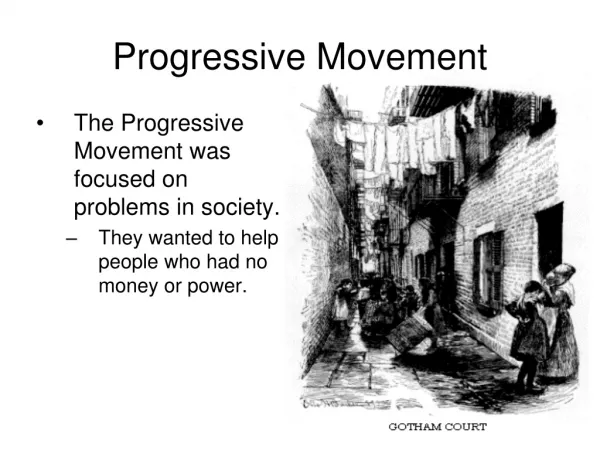
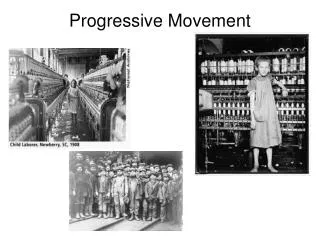
Chicago in transition • Problems: • Urban slums • Poverty • Dangerous working conditions • Corruption in politics • Political machines • Exploitive monopolies
Progressivism • Wanted to address these problems of urban centers like Chicago • Many progressive reformers were well-educated and well-informed middle-class Americans, including many women, journalists, small business owners, and college professors.
Common elements of Progressives • Promoted social justice concerns • Faith in government intervention in society • “Gospel of efficiency” • Order and organization
Progressive beliefs • Good government should be honest, efficient, and managed by professional public servants. • Progressive reform sought: • Moral reform • Get rid of prostitution and gambling and those who allowed it • Urban political reform • Get rid of corruption, bribery, patronage, and fraud • Civic reform • Make Chicago a safer, cleaner, better place to live
Local writers and Exposés Muckrakers and Upton Sinclair
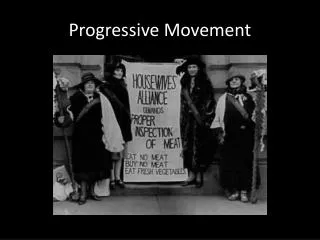
Muckrakers • Progressive movement fueled by writers and journalists who were called muckrakers. • Exposed the dirty, seedy, and unethical happenings of life in America • Brought about a feeling of moral outrage
Upton Sinclair • Began as a journalist for a socialist newspaper • Came to Chicago in 1905 to investigate the Union Stock Yards and the meatpacking industry
Sinclair’s task • Expose the meatpacking industry • Expose the exploitative relationship between owners and employees • Intended for his work to support socialism
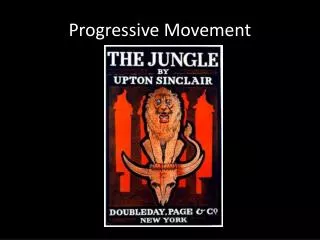
Sinclair’s book • The novel, The Jungle, published in 1906 • Books tells the story of an immigrant who comes to America and works in the Union Stock Yards of Chicago • Main character: JurgisRudkus gets crushed by the vicious capitalist system. • Jurgis converts to socialism
Response to the Jungle • Readers did not remember this book for Sinclair’s argument for socialism but rather for: exposing the unimaginable filth that could be found on a daily basis at meatpacking plants. • Exposed the meatpacking industry for packaging contaminated, spoiled, unclean, and occasionally doctored meat.
Roosevelt Connection! • President Theodore Roosevelt began to push for new federal laws • Health standards on the meat packing industry • Passed the Meat Inspection Act and the Pure Food and Drug Act in 1906.
Local writing • British writer and reformer William T. Stead came to Chicago for the Columbian Exposition. • He was appalled by the rampant vice he found here. He told of what he saw in his 1894 book, If Christ Came to Chicago.
If Christ Came to Chicago • Stead described Chicago as a city full of materialistic young men. • Called local society women selfish and lazy • He believed Jesus would not like Chicago
What the book exposed • Stead was appalled by Chicago’s famed “Levee,” known then as the “most notorious red-light district in the nation”– Jon C. Teaford • 200 brothels, countless saloons, dance halls, pawn shops and gambling clubs • The Everleigh Club: a local institution, a “classy and respectable brothel”
Effects of the book? • The Chicago Tribune called it “a directory of sin” • Sold 10,000 copies locally right away • Generated publicity but little in the way of actual reform • Most Chicago politicians avoided moral reform and ideas of the Progressives • Regulation of vice, confined to the boundaries of the Levee.