
SlideServe
Menu
Préférences
© SlideServe · v2026

Test for the lesson 1
judson avatar
28 diapositives · 474 Views · Sep 04, 2014

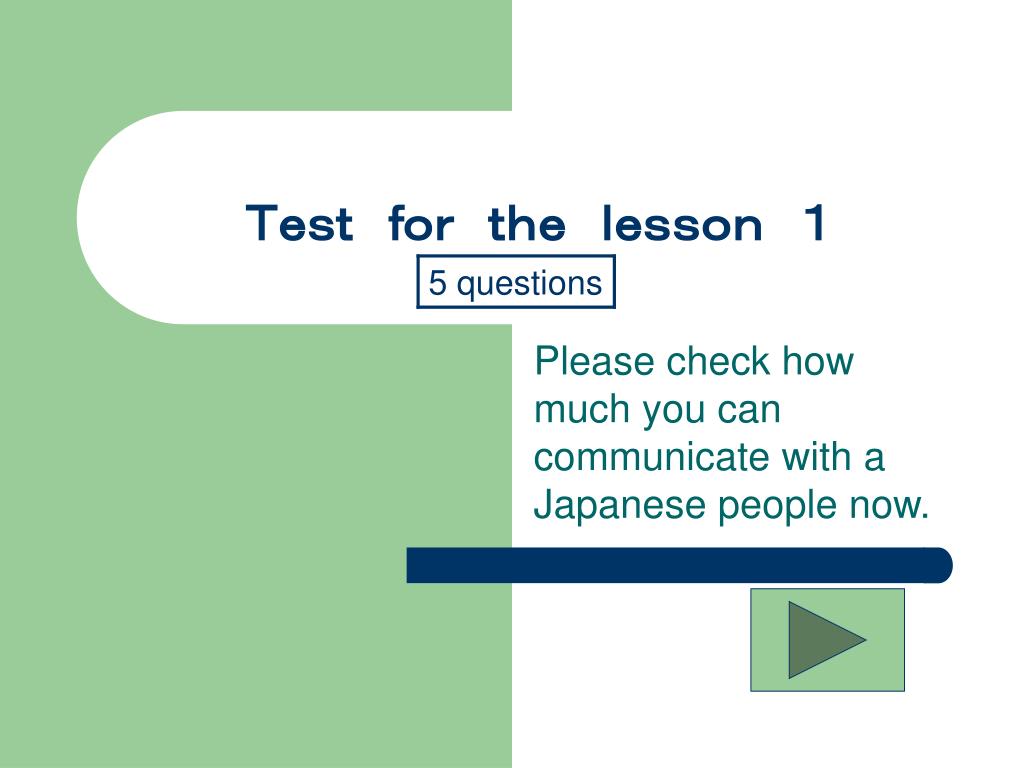
Test for the lesson 1. Please check how much you can communicate with a Japanese people now. 1. What is “ Hello ” in Japanese?. Konbanwa Konnichiwa Ohayou Oyasumi. 2.What is “ Excuse me ” in Japanese?. Hajimemashite Itadakimasu Gochisousama Sumimasen. “ Excuse me ” is “ sumimasen.
Test for the lesson 1 - slide 1
01 / 28Test for the lesson 1
1 / 17

Télécharger la présentation

Test for the lesson 1
Une image / un lien ci-dessous est fourni (tel quel) pour télécharger la présentation

Politique de téléchargement : le contenu du site vous est fourni TEL QUEL pour votre information et votre usage personnel ; il ne peut être vendu, concédé sous licence ni partagé sur d’autres sites sans l’accord de son auteur.Le contenu vous est fourni TEL QUEL, pour votre information et votre usage personnel uniquement. Téléchargez la présentation en cliquant sur ce lien. Lors du téléchargement, si vous ne parvenez pas à télécharger une présentation, l’éditeur a peut-être supprimé le fichier de son serveur.Pendant le téléchargement, si vous ne parvenez pas à obtenir une présentation, le fichier a peut-être été supprimé par l’éditeur.

F I N

Plus de contenu associé

Transcription de la présentation
  1. Test for the lesson 1Test for the lesson 1 Please check how much you can communicate with a Japanese people now.

  2. 1. What is “Hello” in Japanese? • Konbanwa • Konnichiwa • Ohayou • Oyasumi

  3. 2.What is “Excuse me” in Japanese? • Hajimemashite • Itadakimasu • Gochisousama • Sumimasen

  4. “Excuse me” is “sumimasen “hajimemashite” means “How do you do?” “Itadakimasu” is said before eating “gochisousama” is said after eating Correct

  5. 3. How can you say “A is B” ? • A wa B desu. • A desu B wa. • A wa desu B. • B wa A desu.

  6. “A is B” is said like “A wa B desu.” “A desu B wa” and “A wa desu B” don’t make any sense. “B wa A desu” is saying opposite “B is A.” Correct

  7. 4. What is this mean?“watashi wa gakusei desu.” • “you are a student.” • “I am a student” • “you are a teacher.” • “I am a teacher.”

  8. “watashi wa gakusei desu.”means “I am a student” “A is B” = “A wa B desu” “Watashi” means “I” “anata” means “you” “sensei” means “teacher” “gakusei” means “ student” Correct

  9. 5. How do you response to “douzo yoroshiku” ? • “genki desu” • “doumo” • “kochirakoso” • “arigatou”

  10. “douzo yoroshiku” means “nice to meet you”. So, you should say “kochirakoso, douzo yoroshiku” that means “Nice to meet you, too.”, but shortly only “kochirakoso” that means “Me, too.” “genki desu” means “I’m fine” “doumo” is very informal of saying “thank you” “arigatou” means also “thank you” but much more natural than saying only “doumo” Correct

  11. Good job! Please go to “the lesson 2” and learn more!

  12. Incorrect “konbanwa” means “good evening”

  13. Incorrect “Ohayou” means “Good morning”

  14. Incorrect “Oyasumi” means “good night”

  15. Incorrect “Hajimemashite” means “How do you do?”

  16. Incorrect “Itadakimasu” is said before eating

  17. Incorrect “gochisousama” is said after eating

  18. Incorrect It doesn’t make any sense.

  19. Incorrect It doesn’t make any sense.

  20. Incorrect “B wa A desu” means “B is A” Opposite!!

  21. Incorrect “A is B” = “A wa B desu” “watashi” means “I” “anata” means “you” “sensei” means “teacher” “gakusei” means “ student”

  22. Incorrect “A is B” = “A wa B desu” “watashi” means “I” “anata” means “you” “sensei” means “teacher” “gakusei” means “ student”

  23. Incorrect “A is B” = “A wa B desu” “watashi” means “I” “anata” means “you” “sensei” means “teacher” “gakusei” means “ student”

  24. Incorrect “genki desu” means “I’m fine.” It is the one of ways to response to the question “ogenki desu ka?” that means “ How are you?”

  25. Incorrect “genki desu” means “I’m fine.” It is the one of ways to response to the question “ogenki desu ka?” that means “ How are you?”

  26. Incorrect “genki desu” means “I’m fine.” It is the one of ways to response to the question “ogenki desu ka?” that means “ How are you?”

  27. Incorrect “doumo” is informal style of saying “thank you.”

  28. Incorrect “arigatou” means “thank you” More politely you can say “arigatou gozaimasu”