Exploring the Opportunities and Risks of Digitally Signed Qualifications
10 likes | 116 Vues
This document delves into the transformative potential of digitally signed qualifications, exploring how they can enable self-verification and the creation of recipient-specific certifications. It addresses important considerations around granularity, including the level of detail required in qualifications. However, it also raises critical concerns about privacy risks, such as hacking, social engineering, and unintended disclosures. The need for robust technical protections and sustainable business models that prioritize privacy interests is emphasized to balance benefits and risks.


Exploring the Opportunities and Risks of Digitally Signed Qualifications
E N D
Presentation Transcript
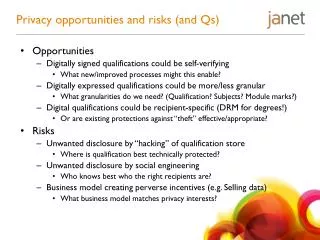
Privacy opportunities and risks (and Qs) • Opportunities • Digitally signed qualifications could be self-verifying • What new/improved processes might this enable? • Digitally expressed qualifications could be more/less granular • What granularities do we need? (Qualification? Subjects? Module marks?) • Digital qualifications could be recipient-specific (DRM for degrees!) • Or are existing protections against “theft” effective/appropriate? • Risks • Unwanted disclosure by “hacking” of qualification store • Where is qualification best technically protected? • Unwanted disclosure by social engineering • Who knows best who the right recipients are? • Business model creating perverse incentives (e.g. Selling data) • What business model matches privacy interests?