Water Cycle
Explore the water cycle's continuous movement of water on, above, and below Earth’s surface. Learn how solar energy drives this cycle, causing state changes among liquid, vapor, and solid forms of water. Discover the various reservoirs involved, including rivers, oceans, and the atmosphere, as well as the processes like evaporation, condensation, and precipitation that reshape geological features. Gain insight into the concepts of water sources and sinks, understanding how water balance affects our ecosystems.

Water Cycle
E N D
Presentation Transcript
Water Cycle Mr. Fleming
Big Ideas • Matter is finite on earth. • All matter will occur in three states of matter over a long enough period of time. • Cycles are synonymous with circles.
Content Standards • D 20. Explain how solar energy causes water to cycle through the major Earth reservoirs.
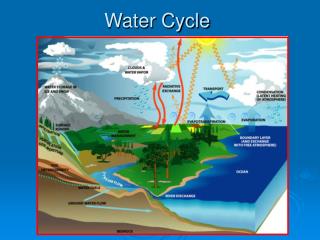
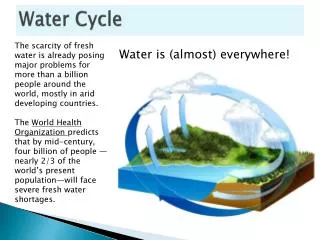
Water Cycle • Continuous movement of water on, above and below the surface of the Earth. • Changes states among liquid, vapor, and solid.
Water Cycle • The sun drives the water cycle. It is the exchange of heat energy, which leads to temperature changes. • Reshapes the geological features of the Earth, through such processes as erosion and sedimentation.
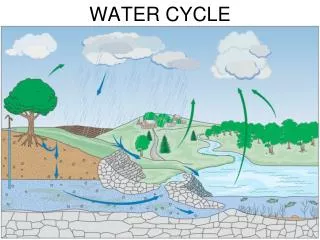
Reservoirs • The water moves from one reservoir to another, such as from river to ocean, or from the ocean to the atmosphere. (evaporation, condensation, precipitation, infiltration, runoff, and subsurface flow) • Purifies water, replenishes the land with freshwater, and transports minerals to different parts of the globe.
Source vs. Sink • When more water leaves an area than enters it is considered to be a source of water. • When more water enters an area than leaves it is considered to be a sink. • Source = gain. • Sink = loss.
Water Cycle Recall • What drives the water cycle? Energy from Sun • What is the difference between a source and a sink? Source=Gain of Water Sink= Loss of Water
Draw a picture showing the difference in the movement of surface water on a paved road in comparison to a sandy beach.