Simulation of Hadronic and Electromagnetic Interactions in Calorimeters Using Geant4
This study presents a comprehensive simulation of hadronic and electromagnetic processes in a calorimeter setup using Geant4. We analyze the efficiency, energy loss, and shower profiles for two types of absorbers (Pb and Fe) under various conditions with a π+ particle beam having energies ranging from 0.5 to 100 GeV. Key findings include a high efficiency of ~95% for 12 mm thickness and differing energy loss profiles between Pb and Fe. Future work will focus on optimizing geometry and materials for improved photon detection.

Simulation of Hadronic and Electromagnetic Interactions in Calorimeters Using Geant4
E N D
Presentation Transcript
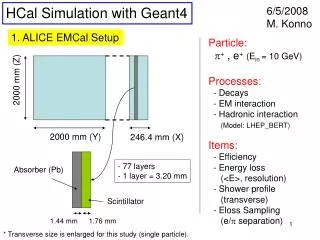
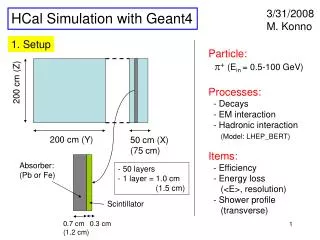
0.7 cm (1.2 cm) 0.3 cm 3/31/2008 M. Konno HCal Simulation with Geant4 1. Setup Particle: +(Ein = 0.5-100 GeV) Processes: - Decays - EM interaction - Hadronic interaction (Model: LHEP_BERT) Items: - Efficiency - Energy loss (<E>, resolution) - Shower profile (transverse) 200 cm (Z) 200 cm (Y) 50 cm (X) (75 cm) Absorber: (Pb or Fe) • - 50 layers • 1 layer = 1.0 cm • (1.5 cm) Scintillator
2. Particle Shot Single particle (+, Ein = 10 GeV) (Absorber: Fe, 12 mm)
3. Energy loss in calorimeter (Absorber: Fe, 12 mm) (same data in log scale) Lower tail seen
4. Efficiency (for shower) ~95 % for 12 mm ~85 % for 7 mm
5. Energy loss (Eloss>50MeV) * Secondary particles flow out?
6. Energy resolution (RMS/Mean, Eloss>50MeV) * Only small fraction of particle energy measured. It’s not the total energy.
7-1. Shower profile - dE/dx vs. x (beam direction: x) (Absorber: Pb, 7mm) (Absorber: Fe, 7 mm) * The dE/dx distributions are different between Pb and Fe.
7-2. Shower profile - dE/dx vs. x (beam direction: x) (Absorber: Pb, 12 mm) (Absorber: Fe, 12 mm) * The dE/dx distributions are different between Pb and Fe.
8-1. Shower profile - dE/dr vs. r (Absorber: Pb, 7mm) (Absorber: Fe, 7 mm)
8-2. Shower profile - dE/dr vs. r (Absorber: Pb, 12 mm) (Absorber: Fe, 12 mm)
9-1. Shower profile – R vs. Ein • The radius not changing much with Ein • The energy loss is centered • (In other words, a long tail seen around the center) • R(Fe) < R(Pb)
9-2. Shower profile – R vs. Ein • The radius not changing much with Ein • The energy loss is centered • (In other words, a long tail seen around the center) • R(Fe) < R(Pb)
10. Summary • The energy loss (<E>, E) and efficiency are • not so different between two absorbers Pb and Fe. • Efficiency: ~85% for absorber length = 35 cm (0.7 cm x 50 layers) • Efficiency: ~95% for absorber length = 60 cm (1.2 cm x 50 layers) • R80(Fe, 12mm): ~12 cm, R80(Pb, 12mm): ~21 cm • R(Fe) < R(Pb) Next to do • - Put EMCal in front of HCal • - Introduce the photon detection efficiency • Study the segmentation in YZ plane • with PYTHIA jet information as Pb+Pb collisions • Optimize the materials and geometry parameters • to fit in ALICE detector • Try to use other hadronic models