SlideServe
Menu
Préférences
© SlideServe · v2026

Traditional African Society

junior avatar
24 diapositives · 474 Views · Aug 06, 2014

Traditional African Society. What is Culture?. What Are Some Unique Aspects Of Our Culture?. Tradition Societies. Rural Areas . Sub-Saharan . Africans That Live in Rural Areas. Cities Share Some Characteristics.
Traditional African Society - slide 1
01 / 24Traditional African Society
1 / 17

Télécharger la présentation

Traditional African Society
Une image / un lien ci-dessous est fourni (tel quel) pour télécharger la présentation

Politique de téléchargement : le contenu du site vous est fourni TEL QUEL pour votre information et votre usage personnel ; il ne peut être vendu, concédé sous licence ni partagé sur d’autres sites sans l’accord de son auteur.Le contenu vous est fourni TEL QUEL, pour votre information et votre usage personnel uniquement. Téléchargez la présentation en cliquant sur ce lien. Lors du téléchargement, si vous ne parvenez pas à télécharger une présentation, l’éditeur a peut-être supprimé le fichier de son serveur.Pendant le téléchargement, si vous ne parvenez pas à obtenir une présentation, le fichier a peut-être été supprimé par l’éditeur.

F I N

Plus de contenu associé

Transcription de la présentation
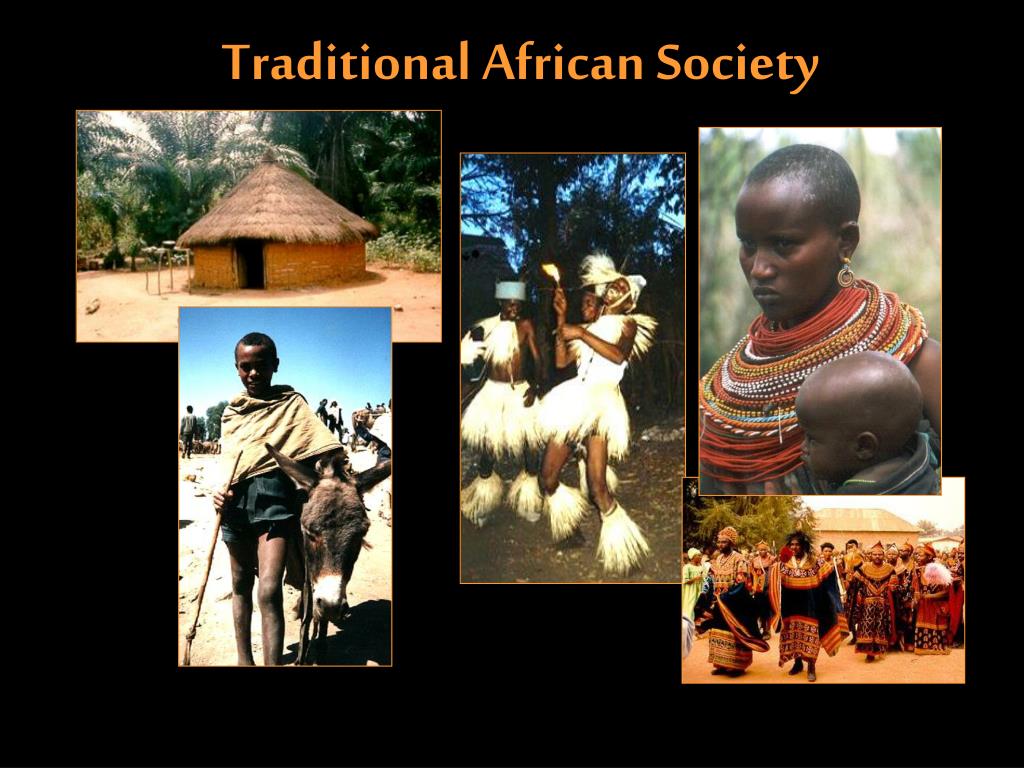
  1. Traditional African Society

  2. What is Culture? What Are Some Unique Aspects Of Our Culture?

  3. Tradition Societies Rural Areas Sub-Saharan Africans That Live in Rural Areas Cities Share Some Characteristics

  4. African Culture Helps Us Define Some of the Unique Characteristics of the Region • Language • Classification of the Individual • Tribal Importance • Ceremonies • Religion • Family Structure

  5. 1000 different languages; 1000+ different tribes

  6. An African’s “Search for Identity” 1. Nuclear Family 2. Extended Family 3. Age-Set 4. Clan 5. Lineage (ancestry) TRIBE (communal living)

  7. Identity Of The Tribe • Scarification:Identify themselves with their tribes in a physical way or used to signify an important time in their lives. • Initiation Rituals:Ceremony that makes them part of the tribe. (Naming, Coming of Age, Wedding, and Death Ceremonies)

  8. Mask With Headcloth, Zaire (19c) Tribal Mark --> Scarification

  9. Kisokolo Initiation Costume, Democratic Republic of the Congo

  10. Kisokolo Initiates, Democratic Republic of the Congo, 1990

  11. Dogon Ancestor Rituals

  12. Tribe Africa : :: America : Ethnic Group

  13. Traditional Family Structures C C Nuclear Family: C H W W C C U Cs GP C C Extended Family: C H W W C C GP Cs A

  14. Family Group, Tanzania

  15. Problems of Tribalism Today 1. The tribe is more important than the nation. 2. Communication problems. 3. Inter-tribal warfare --> civil wars. 4. Tribal favorites for government jobs: Nepotism Breaks down tribal traditions. Urbanization: Tribal intermingling on the job.

  16. Religions in Africa ISLAM  25%* Nigeria largest sub-Saharan Muslim countries. CHRISTIANITY -> 20%

  17. Traditional African Religion ANIMISM 1. Belief in one remote Supreme Being. 2. A world of spirits (good & bad) in all things. 3. Ancestor veneration. 4. Belief in magic, charms, and fetishes. 5.Diviner mediator between the tribe and God.

  18. African Diviner, Shaman, Priest

  19. Ancestors

  20. Fetishes

  21. Fetishes

  22. Rubbing Oracle, wood

  23. Common Traits or Characteristics of Traditional African Tribal Life • The good of the group comes ahead of the good of the individual. • All land is owned by the group. • Strong feeling of loyalty to the group. • Important ceremonies at different parts of a person’s life. • Special age and work associations. • Deep respect for ancestors. • Religion is an important part of everyday life. • Government is in the hands of the chiefs [kings].