Download
1 / 11
110 likes | 253 Vues
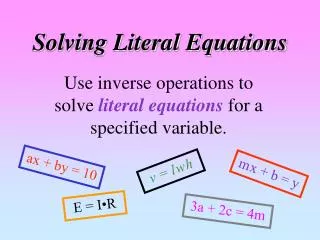
This lesson introduces students to literal equations, focusing on solving for unknowns using algebraic principles. We start with a challenge: find four consecutive numbers that sum to 138. Through various examples, we compare simple equations with multiple variables, emphasizing that literal equations differ from traditional equations by not having a numeric solution. We also review inverse operations—addition, subtraction, multiplication, and division. Students will practice solving literal equations and complete an exit ticket example featuring the equation 3x + y = 12.

E N D
Do Now: 1. Four consecutive numbers add to 138. What are the four numbers?
Example One: • 2x= 10 vs. 2x= y
Example Two: • X+3=5 vs. X+y=z
Example Three • X-4= 12 vs. x-B=C
Example Four: • x/3 = 4 vs. x/d=e
Example Five: • 2x+5=13 vs. 2x+n=p
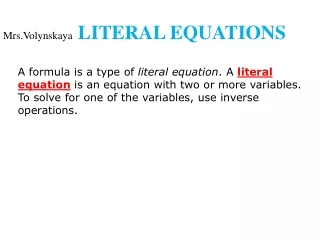
Literal vs. Equations • Literal Equations will never have a number value as an answer. • Literal Equations will have multiple variables.
Inverse Operations: • Addition • Subtraction • Multiplication • Division
Practice Problems! • Try some on your own or with your group members.
Exit Ticket • Solve the literal equation for “x” • 1. 3x+y= 12