Understanding Vector Functions: Magnitude, Direction, and Operations
Dive into the world of vector functions with this comprehensive guide covering key concepts such as the magnitude and direction of vectors. Learn how to express vector coordinates as ordered pairs and break down vectors into horizontal and vertical components. This resource includes quizzes on parametric and polar functions, preparing you for the upcoming test. Master the principles of vector addition both in component form and graphically, and explore the characteristics that define vectors. Ideal for enhancing your knowledge in non-Cartesian functions!

Understanding Vector Functions: Magnitude, Direction, and Operations
E N D
Presentation Transcript
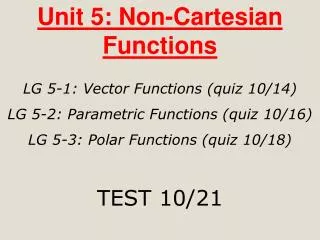
Unit 5: Non-Cartesian Functions LG 5-1: Vector Functions (quiz 10/14) LG 5-2: Parametric Functions (quiz 10/16) LG 5-3: Polar Functions (quiz 10/18) TEST 10/21
Magnitude : size/length • Direction: direction from one place to another (has 2 parts – an angle and a cardinal direction) The notation of a vector is a single letter in bold (v or u, etc)or a single letter with an arrow on top A Vector is a directed line segment that has two and only two defining characteristics:
Vectors are made up of the Horizontal (x) and Vertical (y) Components Express the vector coordinates below as ordered pairs in simplest radical form. Components
If a position vector has length 8 cm and direction 60°SW, then find the horizontal & vertical components.
To add vectors in component form, just add the horizontal components and the vertical components. To add vectors graphically, just play “follow the leader.” Then draw a new vector from the start of the first to the end of the second. The new vector is called the resultantor displacement vector. Vector Operations