Image Application Redux
This document outlines a robust architecture for streaming video using Redux, focusing on Quality of Service (QoS) management. The receiver subscribes to a video stream and must maintain a balanced load from the video server, avoiding both starvation and flooding. Key components include distributed QoS code, TCP communication for connection management, and sender-receiver feedback channels. The sender application pulls images, and the receiver processes them, ensuring adherence to Service Level Agreements (SLA) while monitoring CPU usage and managing timing effectively.
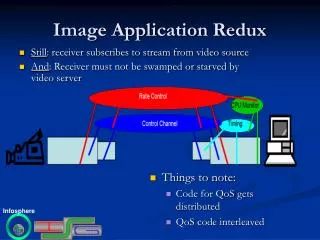

Image Application Redux
E N D
Presentation Transcript
Image Application Redux • Still: receiver subscribes to stream from video source • And: Receiver must not be swamped or starved by video server • Things to note: • Code for QoS gets distributed • QoS code interleaved
Base Code Just TCP communication Binding, connecting, marshalling, etc. No application code No QoS
Sender Control • Sender-side Feedback channel • MUXs control messages • Binds, connects • TCP transport
Sender SLA Implements SLA pieces for sender Param’ed by the SLA Can send messages over the control channel Responds to receiver feedback
Sender Application • Pulls image from source • Uses Infopipe to send image
Receiver Control • Receiver-side feedback channel • DeMUXs control messages • Binds, connects • TCP transport • Mirrors sender’s control code
Timing Code • Inserts variables for time • Inserts system timing calls
CPU Monitor • Calls system for resource usage • Uses timing from timing aspect • Calculates CPU use %
Receiver SLA • Implements Receiver end of SLA • Returns feedback via control channel • Acts based on CPU % usage data
Receiver Application • Processes images received off network by Infopipe