Download
1 / 12
120 likes | 217 Vues
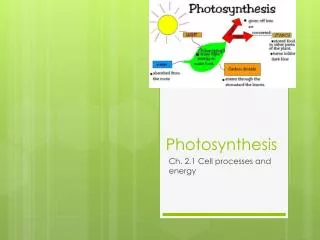
This presentation provides an overview of photosynthesis, the fundamental process through which plants, algae, and cyanobacteria convert sunlight into energy. It explains how carbon dioxide and water are transformed into glucose and oxygen, highlighting the roles of chloroplasts and chlorophyll. The presentation covers light-dependent and light-independent reactions, detailing how ATP is generated and used in the Calvin Cycle. By understanding photosynthesis, we appreciate the vital role plants play in sustaining life on Earth.

E N D
Photosynthesis By Deepthi Sri
Overview • All energy on earth comes from the sun. • We depend on: • Plants • Algae (underwater plants) • Cyanobacteria (photosynthetic bacteria) • To provide this energy to us!
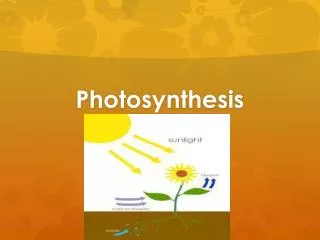
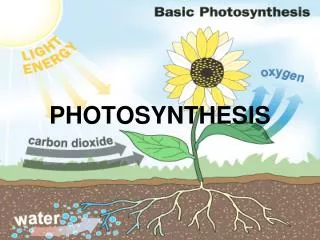
Overview • Carbon dioxide and water are taken in by plants • Plants absorb light energy and convert it to a usable form. • ATP • Energy is used to “fix” carbon dioxide into sugar molecules • Chemical energy • Sugar is converted to starch and stored for use by the plant, and by animals when they eat plants.
Chloroplasts • Have TWO membranes • A “bi-bilayer!” • The inner membrane is called the thylakoid. • The thylakoid is folded and looks like stacks of coins called granum (grana singular). • The stroma is the space surrounding the granum Image source: http://www.daviddarling.info/encyclopedia/C/chloroplasts.html
Chloroplasts • Chlorophyll molecules are embedded in the thylakoid membrane • Act like a light “antenna” • These molecules can absorb sunlight energy. Image from Biology 11: College Preparation. Pg 73. Nelson, Toronto. 2003.
Light (dependent)Reactions • Happen ONLY in sunlight • Hence they depend on light! • Light is absorbed by chlorophyll molecules • The energy generates molecules of ATP Image from: Biology 11: College Preparation. Pg 74. Nelson, Toronto. 2003.
Light Independent Reactions(formerly the “dark reactions”) • Happen in sunlight, and in the dark. • Hence “independent of light” • ATP generated by sunlight drives the Calvin Cycle. • Monosaccarides (eg. glucose) are manufactured in the cycle. • Monosaccarides are used to “build” polysaccharides (eg. Starch). Image from: Biology 11: College Preparation. Pg 74. Nelson, Toronto. 2003.
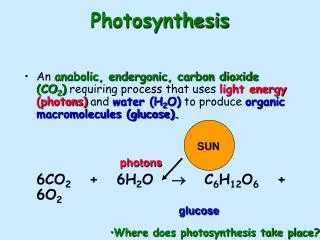
Overall Reaction What is the equation for photosynthesis? carbon dioxide + water glucose + oxygen + energy 6CO2 + 6H2O C6H12O6 + 6O2 + energy
Summary Image from: Biology 11: College Preparation. Pg 74. Nelson, Toronto. 2003.
Why do leaves turn brown in the fall? • It’s all about pigments! • Let’s go outside and collect some leaves!
This powerpoint was kindly donated to www.worldofteaching.com Home to well over a thousand free powerpoint presentations submitted by teachers. This a free site. Please visit and I hope it will help in your teaching