Download
1 / 13
130 likes | 261 Vues
Pedigree analysis is essential for revealing Mendelian inheritance patterns in human genetic disorders. It helps in genetic counseling by mapping data onto family trees, allowing for the understanding of inherited traits and the prediction of future genetic risks. Numerous genetic disorders, such as cystic fibrosis, Tay-Sachs, sickle cell anemia, and Huntington’s chorea, illustrate how simple recessive and dominant traits operate. By analyzing these conditions' inheritance patterns, we can comprehend their impact on individuals and communities and emphasize the cultural importance of avoiding consanguineous matings.

E N D
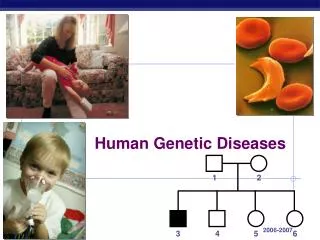
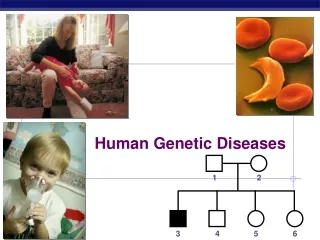
1 2 3 4 5 6 Human Genetic Diseases
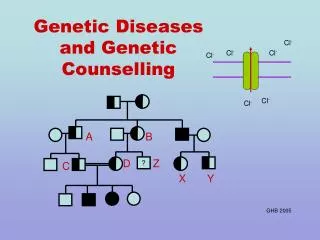
= male = female = male w/ trait = female w/ trait Pedigree analysis • Pedigree analysis reveals Mendelian patterns in human inheritance • data mapped on a family tree
Genetic counseling • Pedigree can help us understand the past & predict the future • Thousands of genetic disorders are inherited as simple recessive traits • from benign conditions to deadly diseases • albinism • cystic fibrosis • Tay sachs • sickle cell anemia • PKU
Cystic fibrosis (recessive) • Primarily whites of European descent • strikes 1 in 2500 births • 1 in 25 whites is a carrier (Aa) • normal allele codes for a membrane protein that transports Cl- across cell membrane • defective or absent channels limit transport of Cl- & H2O across cell membrane • thicker & stickier mucus coats around cells • mucus build-up in the pancreas, lungs, digestive tract & causes bacterial infections • without treatment children die before 5; with treatment can live past their late 20s normal lung tissue
Effect on Lungs Chloride channel transports salt through protein channel out of cell Osmosis: H2O follows Cl– normal lungs airway Cl– Cl– channel H2O cells lining lungs cystic fibrosis Cl– H2O bacteria & mucus build up thickened mucus hard to secrete mucus secreting glands
delta F508 loss of oneamino acid
Tay-Sachs (recessive) • Primarily Jews of eastern European (Ashkenazi) descent & Cajuns (Louisiana) • strikes 1 in 3600births • 100 times greater than incidence among non-Jews • non-functional enzyme fails to breakdown lipids in brain cells • fats collect in cells destroying their function • symptoms begin few months after birth • seizures, blindness & degeneration of muscle & mental performance • child usually dies before 5yo
Sickle cell anemia (recessive) • Primarily Africans • strikes 1 out of 400 African Americans • high frequency • caused by substitution of a single amino acid in hemoglobin • when oxygen levels are low, sickle-cell hemoglobin crystallizes into long rods • deforms red blood cells into sickle shape • sickling creates pleiotropiceffects = cascade of other symptoms
Sickle cell anemia • Substitution of one amino acid in polypeptide chain hydrophilicamino acid hydrophobic amino acid
Sickle cell phenotype • 2 alleles are codominant • both normal & mutant hemoglobins are synthesized in heterozygote (Aa) • 50% cells sickle; 50% cells normal • carriers usually healthy • sickle-cell disease triggered under blood oxygen stress • exercise
1872 Huntington’s chorea (dominant) • Dominant inheritance • repeated mutation on end of chromosome 4 • mutation = CAG repeats • glutamine amino acid repeats in protein • one of 1st genes to be identified • build up of “huntingtin” protein in brain causing cell death • memory loss • muscle tremors, jerky movements • “chorea” • starts at age 30-50 • early death • 10-20 years after start Testing…Would youwant toknow?
Genetics & culture • Why do all cultures have a taboo against incest? • laws or cultural taboos forbidding marriages between close relatives are fairly universal • Fairly unlikely that 2 unrelated carriers of same rare harmful recessive allele will meet & mate • but matings between close relatives increase risk • “consanguineous” (same blood) matings • individuals who share a recent common ancestor are more likely to carry same recessive alleles