Indirect Measurement
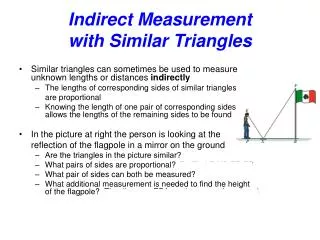
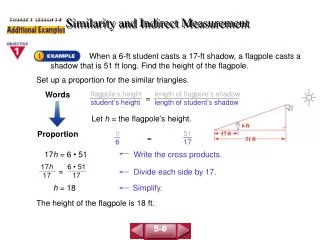
This lesson explores the concept of indirect measurement by applying properties of similar figures. Students will learn to determine unknown measures by setting up proportions based on the relationships between corresponding sides and angles of similar triangles. Through contextual examples, such as measuring the width of a river or the height of a tree using shadows, students will practice solving real-world problems. Exercises include calculating lengths of sides in similar triangles and figuring out distances using diagrams.


Indirect Measurement
E N D
Presentation Transcript
Warm-UpSolve each proportion. • 3 X 2. 6 2.4 5 75 X 8 3. 9 X 4. X 8 27 6 3.5 7 = = X = 20 X = 45 = = X = 2 X = 4
What we are doing… Learn to find measures indirectly by applying the properties of similar figures.
A F B C A A A A E G B B B B C C C C Indirect Measurement…. Notice how all angles are congruent. Which angle corresponds with angle F? Which angle corresponds with angle E? B A B Notice what happens as we turn the triangle. A
F B 3 ft 9 ft A C 4 ft E G X Example 1; Triangles ABC and EFG are similar. Find the length of side EG. Triangles ABC and EFG are similar.
Question 1: 1. Vilma wants to know how wide the river near her house is. She drew a diagram and labeled it with her measurements. How wide is the river?
The diagram: W 21 m 7 m 15 m Work…
Question 2: Julie wants to know how far it is from her house to the big oak tree. She drew a diagram and labeled it with her known measurements. How far is the tree from her house?
16 ft 24 ft 6 ft 4 ft 5 ft Diagram…. Work…..
?? 3 ft 6 ft 2 ft Question 3 A yardstick casts a 2-ft shadow. At the same time, a tree casts a shadow that is 6 ft long. How tall is the tree?
30 ft ????? 3 ft 18 ft Question 4; A 30 ft building casts a shadow that is 18 ft long. A nearby tree casts a shadow that is 3 ft long. How tall is the tree?
AC = 30 D DC = 20 BE = 4 AB = ? E C A B Question 5 Triangles with triangles…
AC = 24 D DC = ? BE = 8 AB = 4 E C A B Question 6;