SlideServe
Menu
Préférences
© SlideServe · v2026

Solving NMR Problems

kadeem avatar
13 diapositives · 3K Views · Sep 06, 2014

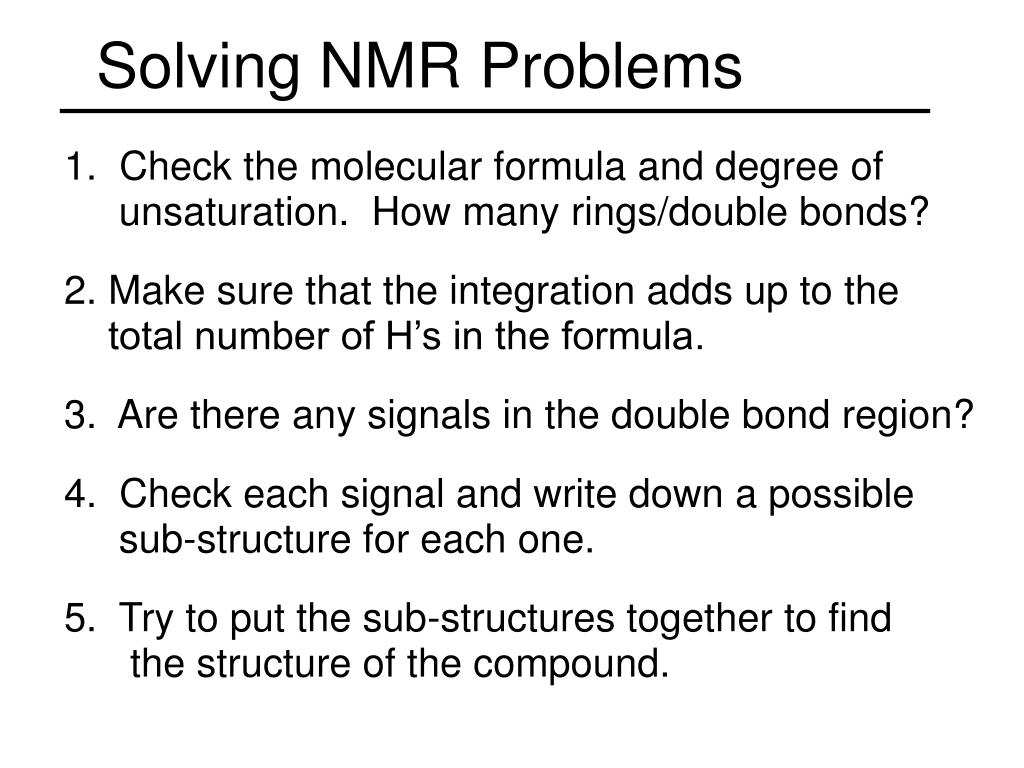
Solving NMR Problems. 1. Check the molecular formula and degree of unsaturation. How many rings/double bonds? 2. Make sure that the integration adds up to the total number of H’s in the formula. 3. Are there any signals in the double bond region?
Solving NMR Problems - slide 1
01 / 13Solving NMR Problems
1 / 17

Télécharger la présentation

Solving NMR Problems
Une image / un lien ci-dessous est fourni (tel quel) pour télécharger la présentation

Politique de téléchargement : le contenu du site vous est fourni TEL QUEL pour votre information et votre usage personnel ; il ne peut être vendu, concédé sous licence ni partagé sur d’autres sites sans l’accord de son auteur.Le contenu vous est fourni TEL QUEL, pour votre information et votre usage personnel uniquement. Téléchargez la présentation en cliquant sur ce lien. Lors du téléchargement, si vous ne parvenez pas à télécharger une présentation, l’éditeur a peut-être supprimé le fichier de son serveur.Pendant le téléchargement, si vous ne parvenez pas à obtenir une présentation, le fichier a peut-être été supprimé par l’éditeur.

F I N

Plus de contenu associé

Transcription de la présentation
  1. Solving NMR Problems 1. Check the molecular formula and degree of unsaturation. How many rings/double bonds? 2. Make sure that the integration adds up to the total number of H’s in the formula. 3. Are there any signals in the double bond region? 4. Check each signal and write down a possible sub-structure for each one. 5. Try to put the sub-structures together to find the structure of the compound.

  2. Proton NMR Spectrum: C9H12

  3. 1H NMR Spectrum: C4H7O2Br s 3H t 2H t 2H 5.0 4.0 3.0 2.0 1.0 0

  4. Electronegative Substituents: Shift Left • CH3Cl 3.1 (one Cl) • CH2Cl2 5.3 (two Cl’s) • CHCl3 7.3 (three Cl’s) d 0.9 d 1.3 d 0.9 d 4.3 d 2.0 d 1.0 H3C—CH2—CH3 O2N—CH2—CH2—CH3 Effect is cumulative

  5. H NR H OR H OAr O C HO Hydrogens on Heteroatoms Chemical shifts for protons on heteroatoms are variable, and signals are often broad (not generally useful). Chemical shift (ppm) Type of proton 1-3 0.5-5 6-8 10-13

  6. 13C NMR Spectroscopy • Carbon-13: only carbon isotope with a nuclear spin • natural abundance of 13C is only 1.1% • (99% of carbon atoms are 12C, with no NMR signal) • All signals are obtained simultaneously using a broad pulse of energy. The resulting “mass signal” changed into an NMR spectrum mathematically using the operation of Fourier transform (FT-NMR) • Frequent repeated pulses give many data sets that are averaged to eliminate noise

  7. 13C NMR Spectroscopy 13C signals go from 0 to 240 ppm. 13C signals: always sharp singlets. (wider range than in 1H NMR) (1H signals: broad multiplets) These two facts mean that in carbon-13 NMR, each separate signal is usually visible, and you can accurately count the number of different carbons in the molecule. Chemical shift affected by electronegativity of nearby atoms: alkane-like range: 0 – 40 ppm (R-CH2-R) heteroatom range: 50 – 100 ppm (O-CH2-R) double bond range: 100 – 220 ppm (sp2 carbons)

  8. Why does 13C NMR give singlets? 13C is only 1.1% natural abundant, so most carbons are 12C, and give no NMR signal. No splitting seen with carbon, because carbons next to the 13C are likely to be carbon-12: Sample of 1-Propanol: 12CH3-12CH2-12CH2-OH 12CH3-12CH2-12CH2-OH 12CH3-13CH2-12CH2-OH 13CH3-12CH2-12CH2-OH 12CH3-12CH2-12CH2-OH 12CH3-12CH2-12CH2-OH 12CH3-13CH2-13CH2-OH 12CH3-12CH2-12CH2-OH

  9. NMR: Number of Signals for 13C NMR How many signals should appear in the carbon-13 NMR spectrum for these compounds? In theory: Signals actually resolved:

  10. 13C NMR Example Note the wide spectral width and the sharp singlets in the spectrum below. Also note that there is no integration with 13C NMR.

  11. 13C NMR: smaller signal to noise ratio more scans (noisesmaller)

  12. 13C NMR Spectrum: C5H11Cl

  13. 13C NMR Spectrum: C4H7O2Br 200 150 100 50 0