Understanding Vibrations and Waves: Key Concepts in Periodic Motion
In Chapter 11, we explore the fundamentals of vibrations and waves, focusing on periodic motion. A vibration repeating back and forth along the same path is termed periodic, with a point of equilibrium being where no net force acts on the object. Key concepts include displacement, amplitude, period, and frequency. The text highlights how the restoring force in simple harmonic motion (SHM) is proportional to the negative displacement, represented by F = -kx. To reinforce learning, homework problems are provided on page 342.

Understanding Vibrations and Waves: Key Concepts in Periodic Motion
E N D
Presentation Transcript
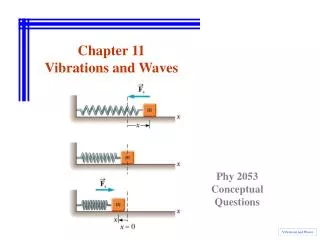
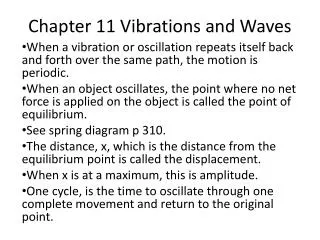
Chapter 11 Vibrations and Waves When a vibration or oscillation repeats itself back and forth over the same path, the motion is periodic. When an object oscillates, the point where no net force is applied on the object is called the point of equilibrium. See spring diagram p 310. The distance, x, which is the distance from the equilibrium point is called the displacement. When x is at a maximum, this is amplitude. One cycle, is the time to oscillate through one complete movement and return to the original point.
A period is the time to complete one cycle. • Frequency is how often cycles occur per unit of time. • Frequency is inversely related to period. • Any vibrating system for which the restoring force is directly proportional to the negative of the displacement is said to be simple harmonic motion. (SHM ) (F=-kx)
Homework • Page 342 pr#1-8