Assessing Aquatic Life Use and Habitat Quality in Ohio's Waterways
This document explores the methodologies for evaluating aquatic life use designations and the impact of habitat attributes on fish and macroinvertebrate communities in Ohio's water systems. It emphasizes the importance of the Qualitative Habitat Evaluation Index (QHEI) in determining habitat quality, identifying causes of impairment, and assessing restoration potential. The analysis covers various habitat attributes, their relation to Index of Biotic Integrity (IBI) scores, and the significance of scale in habitat assessments. The findings aim to guide effective water quality standards (WQS) and restoration efforts.

Assessing Aquatic Life Use and Habitat Quality in Ohio's Waterways
E N D
Presentation Transcript
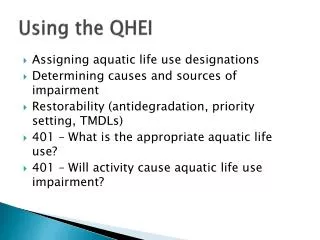
Using the QHEI • Assigning aquatic life use designations • Determining causes and sources of impairment • Restorability (antidegradation, priority setting, TMDLs) • 401 – What is the appropriate aquatic life use? • 401 – Will activity cause aquatic life use impairment?
Back in the 1980s developed list of important habitat attributes • List of factors associated with higher IBIs • Warmwater Habitat Attributes • List of factors associated with lower IBIs • Modified Habitat Attributes • Key for Use Attainability Analyses is to determine if: • Physical habitat features limiting to aquatic life • Are these habitat features feasibly restorable
WWH vs MWH Attributes • Recent/recovering from modifications • Silt/muck substrates • Heavy/moderate silt • Fair/poor development • Low/no sinuosity • Only 1-2 cover types • No fast current • High embeddedness • Max depths < 40 cm • Intermittent/interstitial flow • No channel mod./recovered • Boulder, cobble, gravel substrates • Silt free, silt normal • Good/Excellent development • Mod./high sinuosity • Extensive/moderate cover • Fast current, eddies • Low/normal embeddedness • Max depths > 40 cm
OHIO SPECIFIC TEMPLATE FOR STRATIFICATION Warmwater Lotic Systems Primary HW Streams (<1-3 mi2) Headwater Streams (1-20 mi2) Wadeable Streams (20-300 mi2) Large Rivers (>200-300 mi2) Great Rivers (>6000 mi2) Class A EWH EWH EWH Shoreline Habitat Types (A,B,C) WWH WWH WWH Class B MWH MWH MWH Class B Modified • 3 Types: • Impounded • Channel mod. • -Non acidic MD • 2 Types: • Channel mod. • -Non acidic MD • 2 Types: • Channel mod. • -Non acidic MD Modified Habitat Class C USH USH LRW LRW Adopted in WQS LRW Assessment Tool • 1 Type: • Other (case specific) • 2 Types: • Drainage maint. • -AMD ORSANCO • 2 Types: • Drainage maint. • -AMD
Importance of Scale of Disturbance • Streams are open ecosystems, scale of impact is important • Scale influences both fish and macroinvertebrate communities • Need to take scale into account when doing use designations: • Local reach limitations may be overcome in high quality watershed • Local reach limitations may be more limiting in poor quality watershed (physical)
How Scale of Impacts Can Affect Development of Targets or Criteria
Indiana and Minnesota: Habitat and Biological Condition in Upstream Huc-8 to 11 Watersheds
Precision of the QHEI and IBI • Precision of tools is important because it provides confidence in identifying impaired waters or high quality waters (confidence in IBI, ICI, etc) • How many classes of waters can we identify? • Precision is important in dependent and independent variables
Stream Flow is Really a Measure of Available Habitat for Aquatic Life • Stream habitat types or “niches” generally increase with stream size and flow; withdrawal of flow could limit the amount of habitat • Fish are adapted through morphology and behavior to specific habitat types • Bottom, mid-water, top-water • Slow, moderate, fast, swift flow • Soft, fines, gravels, cobbles, boulders • Structures such as undercuts, aquatic plants, rootwads, oxbows, etc. Redside Dace, Top Striped Shiner, Midwater Variegate Darter, Bottom