Resources for Algae Production in Texas
130 likes | 270 Vues
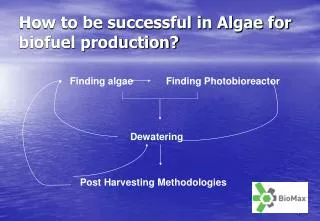
Algae presents a promising yet underutilized renewable fuel source with potential biodiesel yields of 5,000-15,000 gallons per acre annually. Despite its potential, the algae oil production industry faces challenges in reaching cost-effective scales. In Texas, the confluence of suitable climate conditions, natural sunlight, and readily available water and carbon dioxide sources offers an opportunity for sustainable algae cultivation. This analysis explores the capacity for algae growth in Texas, correlating resource availability and land use to estimate production potential and overall contributions to the state's oil consumption.


Resources for Algae Production in Texas
E N D
Presentation Transcript
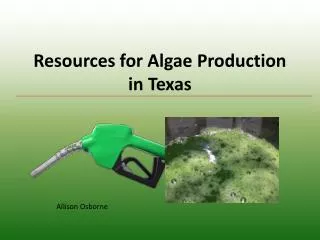
Resources for Algae Production in Texas Allison Osborne
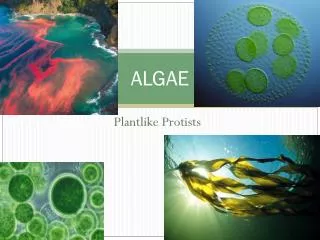
Algae is an Emerging Fuel Resource • Highest productivity for biodiesel: 5,000-15,000 gallons/acre-year. • Immature industry, algae oil production has struggled to cost-effectively scale up. • Couple freely-available sources of water and carbon dioxide for cost-effective algae production. Source of images: Sunrise Ridge Algae, Inc.
Texas Climate and Land • Availability of a suitable climate and sunlight resources in Texas. • Algae can be grown in ponds, shrimp/fish farms, photobioreactors on private land, or closed, vertical reactors on intensively used urban land. Source of images: Greenfuel Technologies, Corp.
GIS Research • Where do wastewater and carbon dioxide resources co-exist in Texas to permit cost-effective algae production? • Given annual sunlight conditions, what volume of algae, and algae oil, can be produced from those resources? • What limitations does land use set? • Equations: • Yield (based on available sunlight)= 3.1536* Insolation* Solar energy capture efficiency/energy content of dry biomass • Yield (based on water and CO2) calculated according to photosynthesis equation: 6(CO2) + 6(H2O) + light -> C6H12O6 + 6(O2)
2 Facilities with Water and CO2 within 0.5 Miles Sunlight Land Use
Calculated Algae Potential at 2 Sites • Accounts for approximately 0.007% of annual crude oil consumption in Texas.
Bioreactor Types Texas Petrochemicals Bayport Complex
8 Facilities with Water and CO2 within 1.0 Miles Land Use Sunlight
Calculated Algae Potential at 8 Sites • Accounts for approximately 0.01% of annual crude oil consumption in Texas. • With 50% recycle, production rises to 2.2 billion barrels (0.2% of consumption in Texas)
Bioreactor Types Polk Street City of Sanger Liberty City City of Winfield Rhodia City of Celeste
Conclusions • Overall, algae oil may provide limited contribution to total Texas oil consumption unless significant water recycle is implemented. • Limited growth potential at some of the identified facilities. • Consider options for transporting wastewater/carbon dioxide to increase production potential.