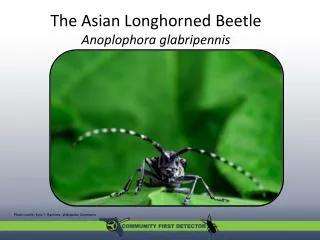
Asian Longhorned Beetle
240 likes | 359 Vues
This document outlines the early detection and management of the Asian Longhorned Beetle (ALB), a pest originally from East Asia, posing a significant threat to U.S. trees. First discovered in New York (1996) and Chicago (1998), ALB larvae are often found in solid wood packing materials. This guide includes information on the beetle's life cycle, preferred hosts, signs of infestation, and eradication efforts. Highlighting the importance of immediate action, the document serves as a resource for identifying and reporting potential ALB sightings to safeguard urban forests.


Asian Longhorned Beetle
E N D
Presentation Transcript
Asian Longhorned Beetle Early Detection Prepared by Gary Watson and Angela Hewitt Funded by a grant from Version 1.0
How does ALB get to the US? • Native to China, Korea, Taiwan • Larvae are transported in solid wood packing materials and shipped to businesses across the U.S.
Known infestations • Infestations were discovered in New York in 1996, and Chicago in 1998
Illinois Infested Trees 98-99 99-00 00-01 01-02 Total Ravenswood 837 472 100 5 1474 Addison 41 15 2 0 59 Summit 8 17 0 0 25 Park Ridge 4 3 0 7 O'Hare 23 0 23 Total 886 508 128 5 1527 Tree loses in N.E. Illinois Data as of 1/18/2002 ALB went undetected in the Chicago neighborhood of Ravenswood for 7 years
The Detection Challenge 9 months 3months ALB Life Cycle
Life Cycle ADULT • Anoplophora glabripennis • 0.75-1.25 inches in length • Emerge from July-October • Live approximately 45-60 days, • Can fly up to a mile
Life Cycle • EGGS • hatch in approximately 11 days • Females are capable of laying up to 90 eggs
Life Cycle LARVA • Feeds underneath bark and then tunnels into center of tree Late Larval feeding Damage Early Larval feeding Damage
Life Cycle PUPA • 19-21 days
Host Trees • Prefers • Maples (Acer spp.) • Will also infest • Horsechestnut (Aesculus hippocastanum) • Elms (Ulmus spp.) • Birches (Betula spp.) • Willows (Salix spp.) • Poplars (Populus spp.) • and many others
Why Eradication? ALB could be as devastating as Dutch elm disease 61% of the trees in Chicago are susceptible to ALB with a value of over a billion dollars
Eradication Program • Tree survey • Tree removal • Quarantine • Replanting
Tree Survey • Ground • Bucket trucks • Climbers
Tree Removal • Northeast Illinois area - 1,522 trees removed • New York City area - 5,297 trees removed
Quarantine Regulatory procedures prevent the movement of infested wood to other areas
Replanting Strategies • Resistant Species • Diverse plantings • Some resistant species • Ginkgo (Ginkgo biloba) • Catalpa (Catalpa spp.)
Five Things to Look For • ADULT • EXIT HOLES • EGG SITES • FRASS • SAP FLOW
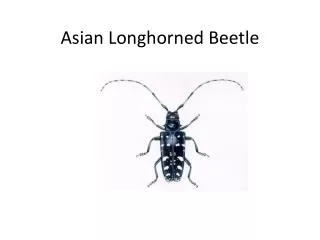
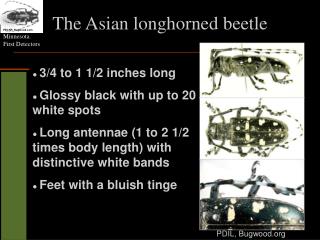
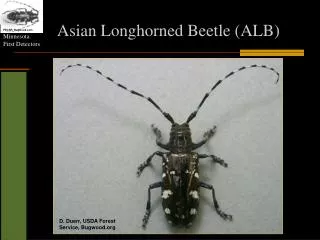
What to Look For • ADULT • Glossy black with irregular white dots, antenna banded with black and white stripes • 0.75 – 1.25 inches in length • Seen July-October
What to Look For • EXIT HOLES • 3/8 inch in diameter • Found predominantly on branches and limbs Growth over exit hole
What to Look For • EGG SITE • oval to round and can be up to ½ inch across
What to Look For • FRASScollects on branches and ground.
What to Look For • SAP FLOW in the spring
Other Longhorned Beetles Cottonwood Borer Whitespotted Pine Sawyer ALB
What to do if you find a beetle? • Capture at least 1 adult beetle • Preserve in 70% alcohol, or put in freezer • In Chicago Call: • USDA – Chicago (312) 742-3386 • Illinois Department of Agriculture 1-800-641-3934