Understanding the Communications Mix: Key Variables Impacting Marketing Strategies
This article explores the critical variables that influence the communications mix in marketing. It covers specific objectives such as brand awareness and customer engagement, differentiates between push and pull strategies, and examines the market dynamics like market share and growth. The discussion also distinguishes between consumer and industrial goods while analyzing the relative effectiveness of various promotional tools such as advertising, sales promotions, and public relations. The insights aim to guide marketers in creating integrated, effective promotional strategies aligned with their product type and consumer behavior.

Understanding the Communications Mix: Key Variables Impacting Marketing Strategies
E N D
Presentation Transcript
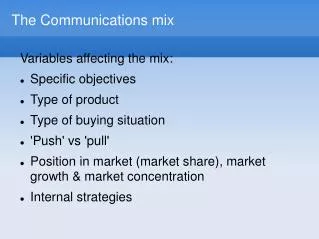
The Communications mix Variables affecting the mix: • Specific objectives • Type of product • Type of buying situation • 'Push' vs 'pull' • Position in market (market share), market growth & market concentration • Internal strategies
Tools / objectives • Advertising: long-term brand image nurturing • Sales promotion: short-term tactical temporary sales booster • Price discounts dilute brand franchise, quality images of the brand • Objectives sought & required response: • Build awareness: PR & advertising • Brand switching: sales promotion supported by advertising or direct mail • Exceptions: some ad + sales prom designed to create database to allow dynamic dialogue & relationships
Setting the promotion mix • Type of product market • Consumer vs. industrial goods Consumer goods • Advertising • Sales promotion • Personal selling • Public Relations Industrial goods • Personal selling • Sales promotion • Advertising • Public Relations
Relative effectiveness of tools • Type of purchase • High involvement: important, expensive, risky, require careful analysis • Low involvement: low risk, frequent purchase, inexpensive Buyers can move from high to low involvement with experience
Response Models • Learn-feel-do: high involvement with high differentiation (classic response hierarchy models) • Do-feel-learn: high involvement but little or no differentiation • Learn-do-feel: low involvement with low differentiation
Relative effectiveness of tools • Purchaser's decision process model: • awareness [advertising & PR] • interest • conviction • purchase [personal selling & sales promotion] • post-purchase (feelings or behaviour) [advertising]
'Push' vs 'pull' strategies • 'Push':strong salesforce supported by trade promotions to push product into the distribution channels & shelves --> distribution penetration • 'Pull': pulling customers into stores & motivating them to pull product off shelf --> advertising to create customer dd • 'Pull' helps 'push' • Kotler: Lever Bros use 'push' vs Procter & Gamble use 'pull'
Integrating the coms mix • Goal: to create bigger impact & be more cost-effective • Publicity & advertising: • major ad campaigns supported by PR / press launches • sales promotion supported by ad or PR or both • direct promotion = direct marketing + sales promotion • on-pack promotion • sales promotion supported by personal sellings