Observing at CARMA
The role of a CARMA observer involves responding to alarms, diagnosing issues, reporting bugs, and monitoring weather conditions for both 1mm and 3mm projects. Observers check and edit observing scripts, run scientific and array health projects, calibrate flux, measure baselines, and assess data quality. Key responsibilities include writing nightly reports, attending meetings to discuss array performance, and troubleshooting operational problems. Observers are also tasked with checking system health and taking necessary actions during configuration changes, ensuring the array operates smoothly and efficiently.
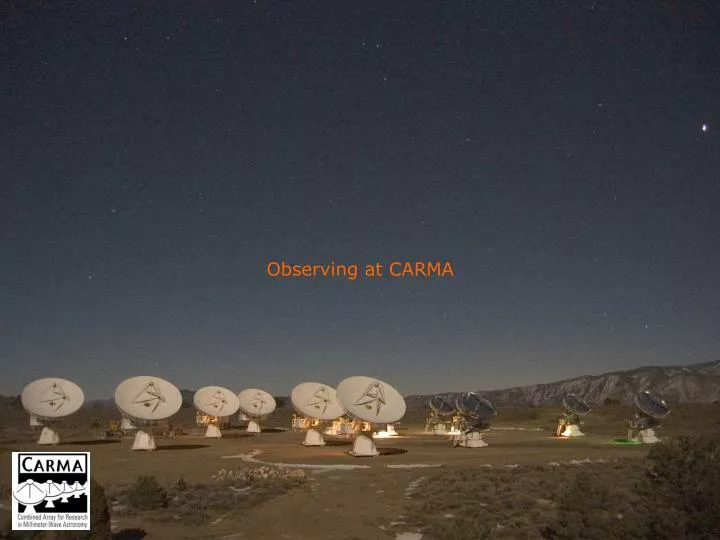

Observing at CARMA
E N D
Presentation Transcript
Responsibilities of a CARMA Observer • Respond to alarms • Diagnose (solve?) problems • Report bugs • Monitor weather (1mm or 3mm project?) • Check/edit observing scripts • Run science projects • Run “array health” projects • Flux calibration • Baseline measurement • Optical & Radio pointing • Beam mapping, aperture efficiency, and much more! • Evaluate data quality; assign grades • Check generator • Check computing system health • Write Nightly Reports • Report on array performance during Obs meetings • Perform special tasks during configuration changes • And be a good “babysitter” after you leave …
The Real Time Display (RTD) Pardo et al. 2005, Wiedner et al. 2004, Pardo et al. 2004
When you notice a problem: • Is it an emergency? • Catastrophic antenna failure (e.g. self-immolation, strangulation)? • Power failure or A/C failure in correlator room • Array idle • Can you solve the problem yourself? (Most problems are routine.) • Check the RTD pages • Check the Observer’s webpage (“Frequent Tasks” and other links) • If you need help: • Talk to the other observer! • Call the “babysitter” • Call/email/IM Nikolaus • Call/email/IM the relevant CARMA person (if you know who it is, and • if it’s during “working hours”) • Email rts@mmarray.org (for software/computer problems) or • hardware@mmarray.org (for hardware problems)
Criteria for 1mm Observing • Check the phase monitor (measure of atmospheric turbulence) • Check the tipper (measure of opacity at 225 GHz) • Check the weather report • Current 1mm criteria: • Earray: (225 GHz) < 0.3 , RMSpath < 350μm • Darray: (225 GHz) < 0.3 , RMSpath < 200μm • C array: (225 GHz) < 0.3 , RMSpath < 150μm • Barray: (225 GHz) < 0.4 , RMSpath < 100μm • import watch1mm • watch1mm.watch1mm(350,0.3,npts=5,nmin=4)
Criteria for 1mm Observing: phase monitor • Check the phase monitor (measure of atmospheric turbulence) • Check the tipper (measure of opacity at 225 GHz) • Check the weather report • Current 1mm criteria: • Darray: (225 GHz) < 0.3 , RMSpath < 200μm • C array: (225 GHz) < 0.3 , RMSpath < 150μm • Barray: (225 GHz) < 0.4 , RMSpath < 100μm • import watch1mm • watch1mm.watch1mm(200,0.3,npts=5,nmin=4)
Selecting a Project • projectsWithinRange • keywords: lstStart, lstStop, band, arrayConfig, maxProj • projectsStartingAt • keywords: lstStart, haLimit, band, arrayConfig, maxProj • schedule (variations: schedule3mm, schedule1mm, scheduleAll) • keywords: arrayConfig, band, days, fixed, mode, pivot, startLST
Starting a Project • To begin running an observing script: • run(‘cs0011_1D_115FlyingSaucer’) • Restarting after a script crash: • restartScript(‘cs0011_1D_115FlyingSaucer’) • run(‘cs0011_1D_115FlyingSaucer restart=True’) • (skips calibration observations already made) • Command line options: • alarm=True • email= • flux, fluxstart=True • pb, pbstart=True • pnt, pntstart=True • opnt=True • tune=True
Stopping a Project • run(‘cs0011_1D_115FlyingSaucer endtrack=13:30’) • Command-line options: • tmax=6.0 • Ending a track: • endtrack(‘13:30’) • endtrack(ut=‘20:00’) • setTmax(‘6.0’) • cancel last resort only! • If the script crashes: • scriptClear
The Quality Report cd /opt/sdp/sciencedata quality proj=cs0011.1D_115FlyingSaucer.1.mir prn=y see=y Quality will TRY to identify sources, gaincals, passcals, and fluxcals based on the information in the observing script, but you must verify these selections!
Grading a Project • gradeProject(‘cs0011_1D_115FlyingSaucer’,1,’A-’,’I.M.Observer’, • ‘C3 & C6 out of array; lost lock on C11 at UT=23:35; high opacity • (tau>0.5) for last 2hrs’,5.0) • If grade ≥ B-, the time will be deducted from the allocation in the PDB. • If grade ≤ C+, no time will be deducted. • Grades, times charged, and comments can be seen in the “summary” file.
“Array Health” Projects • Observe flux calibrators • Determine optical pointing coefficients • Determine radio pointing coefficients • Determine antenna positions (i.e. baseline solution) • Other (less common) “array health” tests: beam pattern mapping; • measure aperture efficiency, etc.
Other Observer Responsibilities • Check generator • Check computing system health • Write the Nightly Report • Report on the status of the array at meetings (daily meetings with CARMA staff; • weekly all-CARMA telecon) • Be a “babysitter” after you leave. • During configuration changes: level antennas, determine initial pointing offsets, • adjust delays, determine initial baseline solution, etc. (Talk by Jin!) • Mitigate damage to the array from “Acts of God”: • wind, snow, hail, forest fires, errant hikers, UFO seekers, Deep Springs • students, etc.