The Roaring 20s: An Era of Change, Jazz, and Social Conflict in America
The 1920s, often referred to as the "Roaring 20s," marked a significant cultural and social transformation in the U.S. post-World War I. Following a return to "normalcy," President Warren Harding's victory in the 1920 election set the stage for vibrant changes. The era saw the rise of jazz, flappers, and consumerism, despite challenges from Prohibition and the Red Scare. Key events included the Harlem Renaissance, labor strife, the Teapot Dome Scandal, and cultural clashes epitomized by trials such as Scopes. This dynamic decade reshaped American society and laid the groundwork for future movements.

The Roaring 20s: An Era of Change, Jazz, and Social Conflict in America
E N D
Presentation Transcript
“A Return to Normalcy” • 1919-President Wilson returns from Paris Peace Conference • Senate rejects Treaty of Versailles • U.S. negotiates a separate treaty with Germany • League of Nations went against policy of isolationism • Wilson suffers a stroke • 1920 Presidential Election • James Cox (D) vs. Warren Harding (R) • Harding promised a “A Return to Normalcy” • Harding wins in a landslide
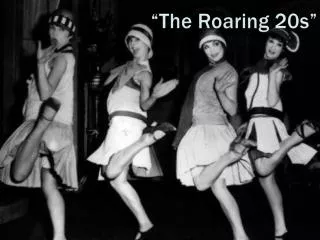
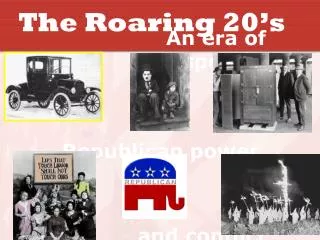
What made the 1920’s roaring? • The Jazz Age • African-American musicians bring Jazz music north • The Flappers • Consumer products • Radio-KDKA in Pittsburgh (1921) • Automobile-From 1.2 in 1913 to 26.2 million in 1929 • Most popular brand is the Model T • Sports-Baseball-Babe Ruth
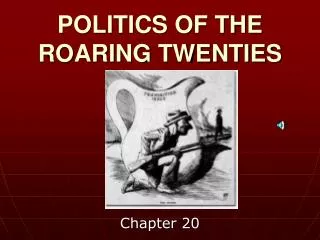
Prohibition“The Noble Experiment” • 18th Amendment (January 1919)bans the manufacturing, distribution, and selling of alcohol • Why prohibit alcohol? • 1 saloon for every 150-200 Americans • Competition among saloon owners caused other vice activities (gambling, numbers) to take place in the saloon • Reduce crime • Reduce other social problems
Enforcement becomes difficult • Possession of alcohol during prohibition was still legal • Organized crime • “Speakeasy” • Bootlegging • 18th Amendment is repealed in 1933 with the 21st Amendment
The Red Scare • Causes-Communist takeover of Russia, Anti-German feelings after World War I, and labor issues • “Palmer raids” under Attorney General A. Mitchell Palmer • Raids led by J. Edgar Hoover • 6,000 people arrested and questioned between November 1919 and January 1920 • Crackdown on civil liberties comes shortly after Schenck v. United States (1919)
Labor Issues • 1920s-Increase in wages • Open Shop vs. Closed Shop • “Welfare Capitalism” • Key Labor figure is John L. Lewis (United Mine Workers) • Unsuccessful strikes in Pennsylvania, Kentucky, and West Virginia
Race • Marcus Garvey and the “Back to Africa” movement • Born in Jamaica and came to Harlem in 1916 • Universal Negro Improvement Association and African Communities League (UNIA-ACL) • Negro World Newspaper • Permanent home in Liberia • Arrested for mail fraud in 1919
Nativism • End of WWI causes a new wave of immigration to the United States • New immigrants were mainly Catholics and Jews from eastern and southern Europe • Prejudice from Protestants and isolationists • Concern that immigrants were taking away jobs and lowering wages • Quota Acts of 1921 and 1924 • Resurgence of the Ku Klux Klan • New Klan founded in 1915
KKK not just strong in the South • Hostile towards blacks, Catholics, Jews, foreigners, and suspected Communists • White robes • Cross burning, whipping, tar and feathering victims • Fraud and corruption caused KKK’s membership and influence to decline in the mid 1920s.
Sacco and Vanzetti • Bartolomeo Vanzetti and Nicola Sacco • Italian immigrants living outside of Boston • April 15, 1920- Two people are killed carrying a payroll deposit from a shoe factory to the bank • Eyewitnesses told police suspected criminal looked Italian • Sacco and Vanzetti were known anarchists • Language barrier at the trial • Both convicted and eventually executed in 1927
The Harlem Renaissance • New Negro Movement by Alain Locke • Harlem becomes a thriving area during the 1920’s • Key figures-Duke Ellington, Louis Armstrong, Billy Holiday, Ella Fitzgerald, Langston Hughes, James Weldon Johnson, Josephine Baker • Apollo Theater • Cotton Club
Scopes-Monkey Trial • State of Tennessee v. Scopes (1925) • High School biology teacher John Scopes was accused of teaching evolution which violated Tennessee law • Like the Plessy case, it was a test case bought by the ACLU (American Civil Liberties Union) • William Jennings Bryan vs. Clarence Darow • Covered by the national media • Scopes found guilty but the verdict was later overturned • Scopes was never retried
“Lucky Lindy” • Charles Lindbergh • May 20-21, 1927-Lindbergh flew from Roosevelt Field (Long Island) to Paris non stop • 3,600 miles in a single engine, single seat plane-“Spirit of St. Louis” • Orteig Prize-New York Hotel Owner Raymond Orteig offered a $25,000 prize to any aviator who flew non stop • Six previous pilots had lost their lives trying to cross the Atlantic • Success of Lindbergh’s flight leads to the development of American commercial aviation • Ticker Tape Parade in Lower Manhattan
Teapot Dome Scandal (1922-1923) • Biggest scandal during President Harding’s administration • Teapot Dome, Wyoming • Several oil producing areas designated as Naval Oil Reserves • Reserves were on public land • 1921-President Harding signs an executive order transferring control of the oil reserves from the Navy Department to the Department of the Interior • DOI director Albert Fall then leased oil reserves to Henry Sinclair and Edward Doheny • Fall received over $400,000 in payments and gifts • Wall Street Journal exposed arrangement
“Silent Cal” • “The business of America is business” • Calvin Coolidge takes over as President on August 2, 1923 • Elected in 1924 • Laissez Faire Economics • Reduction of Taxes • Rejects subsidy for farmers
Foreign Policy • Dawes Plan (August 1924) • Designed to help Germany pay the $33 billion in reparations as required by the Treaty of Versailles • U.S. would give loans to Germany to help them pay the reparations
The Start of the Great Depression • Uneven distribution of wealth • Overproduction by business and agriculture • Lower demand for consumer goods • Buying stock on margin • Stock Market Crash in October 1929 • Smoot-Hawley Tariff (1930)