Mapp v. Ohio: The Impact of the 4th and 14th Amendments on State Court Rights
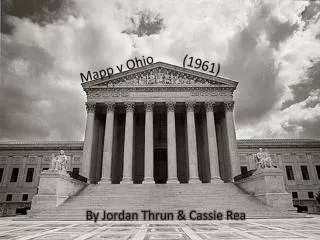
The landmark case of Mapp v. Ohio addressed the intersection of the 4th and 14th Amendments concerning unreasonable searches and seizures. Following a warrantless search of Rachel Simmons’s home based on suspicion of a bomb, the Ohio courts claimed the 14th Amendment only limited national government rights, disregarding its implications for state actions. In a 6-3 decision, the Supreme Court overturned her conviction, affirming that state courts must adhere to the Bill of Rights. This pivotal ruling reinforced privacy rights and established the exclusionary rule at the state level.

Mapp v. Ohio: The Impact of the 4th and 14th Amendments on State Court Rights
E N D
Presentation Transcript
Mapp v. Ohio Rachel Simmons
Background & Freedom at Issue • The 4th and 14th Amendments • With reasonable suspicion of a bomb at the house, the police went to search the home • They entered the house without a search warrant and arrested her • Ohio claimed that the 14th amendment has no guarantees with the fourth amendment in the state courts • In the state courts, they claim that the 14th amendment only limits the rights of the national government • She thought her freedom of thought in the obscenity rule was violated, but the courts disregarded that and focused on the seizure amendment
Decision of the Court • In a 6-3 decision, they overturned her conviction • They claimed the courts could not use the evidence found under the unreasonable search • The point to assuring against an unreasonable search would then be pointless • 14th amendment requires that the state courts must follow the Bill of Rights just as much as the federal government • They were at fault that they did not follow the 14th amendment
Interpretation of Rights • Mapp v Ohio allowed for the exclusionary rule to be used the state court cases • Ultimately, under this the 4th amendment was strengthened to the privacy of Americans • It reinforced the fact that the 14th amendment applies to the states
Sources • http://www.infoplease.com/us/supreme-court/cases/ar19.html • http://www.enotes.com/supreme-court-drama/mapp-v-ohio