Download
1 / 17
170 likes | 293 Vues
Dimensional Analysis is a powerful problem-solving method that utilizes the concept of multiplication by one, allowing you to convert units seamlessly without altering their values. To apply this technique effectively, read the problem thoroughly, identify the necessary measurements and units, and utilize appropriate conversion factors. Always show your work, ensuring units cancel correctly throughout the calculation process. This method is useful for both simple and multi-step conversions, facilitating the transformation of measurements between English and Metric units.

E N D
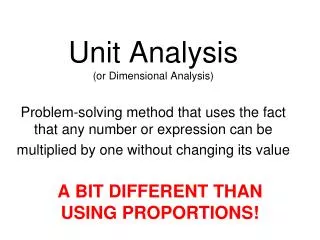
Unit Analysis(or Dimensional Analysis)Problem-solving method that uses the fact that any number or expression can be multiplied by one without changing its value A BIT DIFFERENT THAN USING PROPORTIONS!
Doing Problems • Read problem completely • Determine the measured quantities in the problem and the units • Determine units being requested • Determine conversion factor that will allow you to change to the new unit
Rules • You must use Dimensional Analysis to solve conversion problems • Always show all your work • Include units • Make sure your units cancel out • Everything on the top is multiplied Everything on bottom is divided from the top
Conversion Factors • A ratio (or fraction) derived from the equality between two different units that can be used to convert from one unit to the other. • Conversion factors always equal one because the two values are equal to each other.
Conversion Factors 4 quarters 1 dollar = 1 = 1 1 dollar 4 quarters 60 minutes 1 hour = 1 = 1 1 hour 60 minutes 1 m 100 cm = 1 = 1 100 cm 1 m
Converting from English to Metric Units and Vice versa Use conversion factors that are exact by definition 1 inch = 2.54 cm 1 ounce = 28.35 g 1 quart = 0.946L or 946 mL 1 meter = 39.37 inches 1 kilogram = 2.2 pounds Metric second = English second 1L = 1.0567 quarts
Convert 62.0 inches to centimeters • First we need to map out what we are doing. 62.0 in ___ cm
Convert 62.0 inches to centimeters • Second we need to determine our conversion factor How many centimeters are in one inch? 2.54 cm = 1 in 1 in 2.54 cm Note: We could have also used that 1cm = .394 inch but as a general rule, the larger unit gets the 1! = 1 = 1 2.54 cm 1 in
Convert 62.0 inches to centimeters • Third, we multiply our given by the conversion factor…making sure to arrange the conversion factor so that the units CANCEL! 62.0 in 2.54 cm X = 157.48 cm 1 in Note: Units that are both on the top and the bottom cancel
Convert 62.0 inches to centimeters • Lastly, we make sure that we reached our “destination” and that we have the correct number of significant figures. 157.48 cm 157 cm Note: Conversions factors do not follow significant figure rules, they are not measured and do not show accuracy.
Multiple Conversions • When conversions require several steps, Dimensional Analysis is extremely useful. It helps organize information so we can think through problems step-by-step.
How many feet are in 965 cm? • 1. Map it out: 965 cm ___ ft • 2. Find conversion factors:
How many feet are in 965 cm? 965 cm 1 in 1 ft X X = 31.66 31.7 ft 2.54 cm 12 in
You are cooking for a large group of people. You must change the recipe to accommodate all the guests. How many gallons will 384 teaspoons of vanilla extract occupy? • 1 Tablespoon (T) = 3 teaspoons (t) • 1 cup (c) = 16 Tablespoons • 1 pint (pt) = 2 cups • 1 quart (qt) = 2 pints • 1 gallon (gal) = 4 quarts