Download
1 / 8
80 likes | 208 Vues
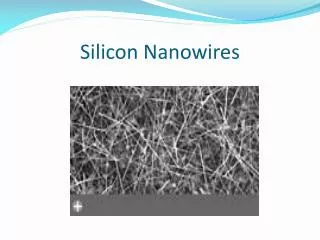
This study presents the development of high-performance lithium-ion battery anodes using silicon nanowires (Si NWs), showing significant improvements in electrochemical performance compared to traditional carbon anodes. Unlike carbon's capacity of 372 mAh/g, silicon offers 4200 mAh/g, a tenfold enhancement. The unique structure of Si NWs accommodates volume changes during cycling, thereby mitigating pulverization. Synthesized via the VLS process, these anodes show remarkable charge transport efficiency while eliminating the need for additional binders, resulting in lighter batteries.

E N D
High-performance lithium battery anodes using silicon nanowires EE235 Nanofabrication John Gerling 4-7-08
Lithium Ion Battery Basics • Electrochemical performance is determined by properties of the anode and cathode materials. • Currently, carbon is used as the anode material. • Charge battery (lithiation): large volume expansion 200-400% LiM • Discharge battery (delithiation): volume contraction xLi+ + xe- + M ↔ charge Lix+M- Electrolyte Li Ion Discharge Anode Cathode Li Ion Charge
Silicon NW Anode • Graphitized carbon (LiC6) – 372 mAh/g • Silicon (Li22 Si5) – 4200 mAh/g (10x improvement!) • Silicon film gets pulverized from volume changes. Si NW can accommodate volume change. • Si NW Anode Advantages: • Small NW diameter allows for better accommodation of large volume changes. • All NW contribute to the capacity. • Direct 1D electronic pathways for efficient charge transport. • No need for binders (extra weight eliminated).
Fabrication and Measurement • Si NWs were synthesized using the VLS process on stainless steel substrates using Au catalyst. • The electrochemical properties were evaluated under an argon atmosphere by both cyclic voltammetry and galvanostatic cycling in a three electrode configuration, with the Si NWs on the stainless steel substrate as the working electrode and Li foil as both reference and counter-electrodes.
Silicon NW Anode Results Peaks related to LiX formation and decomposition, the larger the peak, the larger the increase in formation and decomposition.
Comments and Conclusion • Only 10-20 cycles were performed. Lithium-ion batteries typically have 1000 cycles. More needed here. • 100% charge capacity achieved. 75% capacity discharge. Irreversible capacity loss after first cycle. What is the efficiency of Li-ion batteries now? Wikipedia quotes 99%.