Understanding Quasi-Reversibility in Multi-Class Queueing Networks
70 likes | 202 Vues
In this lecture, we delve into the concept of quasi-reversibility within multi-class queueing networks. We discuss various queueing models, including symmetric queues and their insensitivity properties. Key topics include the state representation of the network, the impact of customer types on routing, and the significance of Poisson arrival rates. We also explore the necessary conditions for a queue to be considered quasi-reversible, emphasizing independent arrival and departure processes. The session concludes with exercises to reinforce the concepts learned.


Understanding Quasi-Reversibility in Multi-Class Queueing Networks
E N D
Presentation Transcript
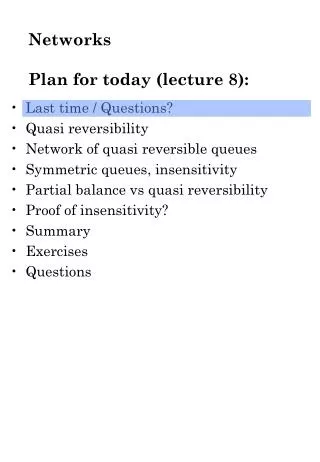
NetworksPlan for today (lecture 8): • Last time / Questions? • Quasi reversibility • Network of quasi reversible queues • Symmetric queues, insensitivity • Partial balance vs quasi reversibility • Proof of insensitivity? • Summary • Exercises • Questions
Customer types : routes • Customer type identified route • Poisson arrival rate per type • Type i: arrival rate (i), i=1,…,I • Route r(i,1), r(i,2),…,r(i,S(i)) • Type i at stage s in queue r(i,s) • Fixed number of visits; cannot use Markov routing • 1, 2. or 3 visits to queue: use 3 types
Customer types : queue discipline • Customers ordered at queue • Consider queue j, containing nj jobs • Queue j contains jobs in positions 1,…, nj • Operation of the queue j:(i) Each job requires exponential(1) amount of service.(ii) Total service effort supplied at rate j(nj)(iii) Proportion j(k,nj) of this effort directed to job in position k, k=1,…, nj ; when this job leaves, his service is completed, jobs in positions k+1,…, nj move to positions k,…, nj -1.(iv) When a job arrives at queue j he moves into position k with probability j(k,nj + 1), k=1,…, nj +1; jobs previously in positions k,…, nj move to positions k+1,…, nj +1.
Customer types : equilibrium distribution • Transition ratestype i job arrival (note that queue which job arrives is determined by type)type i job completion (job must be on last stage of route through the network)type i job towards next stage of its route • Notice that each route behaves as tandem network, where each stage is queue in tandemThus: arrival rate of type i to stage s : (i)Let • State of the network: • Equilibrium distribution
Quasi-reversibility: network • Multi class queueing network, class c C • J queues • Customer type identifies route • Poisson arrival rate per type(i), i=1,…,I • Route r(i,1), r(i,2),…,r(i,S(i)) • Type i at stage s in queue r(i,s) • State X(t)=(x1(t),…,xJ(t)) • Construct a network by multiplying the rates for the individual queues • Arrival of type i causes queue k=r(i,1) to change at • Departure type i from queue j = r(i,S(i)) • Routing
Quasi-reversibility • Multi class queueing network, class c C • A queue is quasi-reversible if its state x(t) is a stationary Markov process with the property that the state of the queue at time t0, x(t0), is independent of(i) arrival times of class c customers subsequent to time t0(ii) departure times of class c custmers prior to time t0. • TheoremIf a queue is QR then(i) arrival times of class c customers form independent Poisson processes(ii) departure times of class c customers form independent Poisson processes.
Exercises • [R+SN] 3.1.2, 3.2.3, 3.1.4, 3.1.3, 3.1.6, 3.3.2