Understanding Atoms, Ions, and Chemical Bonds: A Comprehensive Overview
220 likes | 339 Vues
This summary covers essential concepts in chemistry, including atomic structure, isotopes, and the behavior of electrons in atoms. It explains the differences between cations and anions, the octet rule for achieving stable electron configurations, and the formation of ionic and covalent bonds. The guide provides insights into writing chemical formulas and naming compounds, illustrating rules for combining elements and understanding valence electrons. Key examples, such as diatomic elements and transition metals, are also explored for a clearer understanding of chemical interactions.


Understanding Atoms, Ions, and Chemical Bonds: A Comprehensive Overview
E N D
Presentation Transcript
Atomic Review and Naming Compounds
Electron (e-) orbit/energylevel Proton (p+) nucleus Neutron (n0)
# of p+ p+ + n0
Atoms that have the same number of protons but a different number of neutrons are called Isotopes. Hydrogen Atomic Mass = 1 Atomic Number = 1 Deuterium Atomic Mass = 2 Atomic Number = 1
Atoms can either gain or lose electrons Gain - negatively charged ion. Loses - positively charged ion H : neutral atom H+ : positive ion H- : negative ion
Octet rule: atoms react to acquire a full outer shell: • Give away an e- to another atom. • Take an e- from another atom. • Share an e-with another atom. Ionic bond Covalent bond An ION is an atom that has lost or gained an electron. Lose e- – positive ion OR cation. (metals) Gain e- – negative ion OR anion. (nonmetals)
+1 +3 -3 -2 -1 +2 +4/-4 Remember: The number of the column is equal to the valence electron number. Know that and you figure out the number of electrons lost or gained – the ionic charge
Ionic NaCl Covalent HCl A compound has different characteristic properties than the atoms which form it.
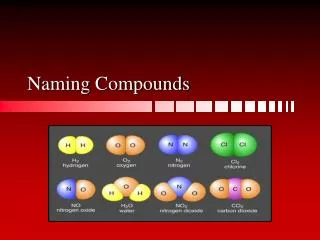
Diatomic Elements: Elements that are most commonly found in a covalent bond with itself. I Have No Bright Or Clever Friends I2H2N2Br2 O2Cl2F2
Chemical formula gives the following information: · The different elements in the compound. · The numberof atoms in the compound.
Writing Rule 1: Write the symbol of the metallic element first. Beryllium combines with Chlorine + 2 - 1 Be Cl Rule 2: Place the combiningcapacityof one element as a subscript of the other element.
Rule 3:Leave subscripts with a value of 1 out. Be Cl2 1 • Two Naming rules: • Write the full name of the metal ionfirst. • Name the non-metal iondropping the last • part of the name and adding the suffix “ide”. beryllium chlor ide
Rule 4: Reduce the subscripts if possible. Magnesium combines with Sulfur + 2 - 2 Mg S MgS magnesium sulph ide
Transition metals can give away different numbers of electrons. To avoid confusion: Brackets are used to show how many electrons the Transition metal is giving away.
Iron (II) chloride Iron (III) chloride + 2 - + 3 - 1 1 Fe Cl Fe Cl FeCl2 FeCl3
Write the name of the ionic compound: +4 -2 Remember: Always look at the anion to see if it has been reduced. If it has, so has the metal. - + Pb O PbO 2 1 lead oxide (IV)
Covalent Compound: Contain two or more NON-METAL atoms. Formed by SHARING valence electrons to fill outer shell – octet rule. • A molecule is the smallest unit of a covalent compound. Non-metal + Non-metal = covalent bonding
Step 1: firstnon-metal is named with a prefix to show the number of atoms. We do not use “mono” for the first non-metal. Step 2: secondnon-metal is named with a prefix AND with the “ide” ending. N O 2 4 nitrogen oxide di tetra dinitrogen tetroxide
Writing formulas Step 1: Write the symbol of each element. Step 2: Use a subscriptto show the number of each type of atom given by the prefix. Do not reducecovalent formulas. di phosphorus oxide penta PO 2 5
Does it have a metal? YES Is it a transition? NO • NO charges • NO criss-cross • Use prefixs • Ends in “ide” • NO • Find charges • Criss-cross • Ends in “ide” • YES • Find charges • Reverse Criss-cross • Use Brackets • Ends in “ide”