Exploring Light and Optics: Telescopes and the Electromagnetic Spectrum
This article delves into the physical properties of light, including refraction and reflection, and how they play critical roles in astronomy. It highlights the significance of different wavelengths and frequencies within the electromagnetic spectrum and their impact on our understanding of the universe. From historic telescopes like Yerkes Observatory to modern marvels such as the Very Large Telescope and large radio arrays like Arecibo, we explore how advancements in optics have propelled astronomical discoveries. Learn about the cutting-edge technology enabling us to see beyond visible light, including UV, X-ray, and gamma-ray observations.

Exploring Light and Optics: Telescopes and the Electromagnetic Spectrum
E N D
Presentation Transcript
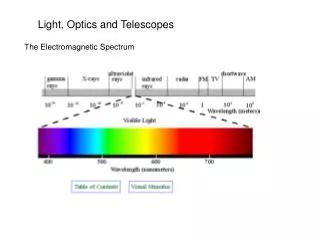
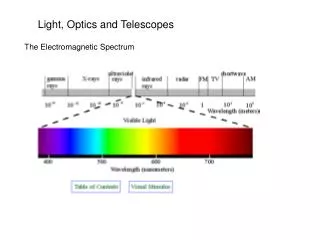
Light, Optics and Telescopes The Electromagnetic Spectrum
Photons of different energies radiate at different wavelengths or frequencies wavelength x frequency = velocity of light ( c) l n = c c = 5 x 10⁵ km/s c = 186,000 miles/s
Atmospheric Windows Visible and radio
Physical Properties of Light Refraction
Refraction is wavelength dependent Reflection
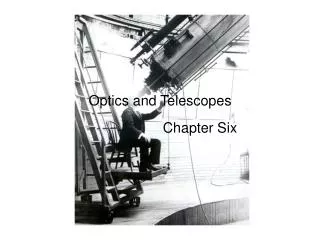
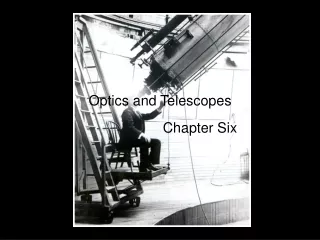
Telescopes -- Refractors Yerkes Observatory – Lake Geneva, Williams Bay Wisconsin
20th Century Large Reflectors Mt Wilson 100-inch – 100 yrs old Palomar 200-inch Cerro Tololo 4 -meter
Modern Observatories Cerro Tololo Interamerican Obs.
Kitt Peak National Obs. Tucson Arizona
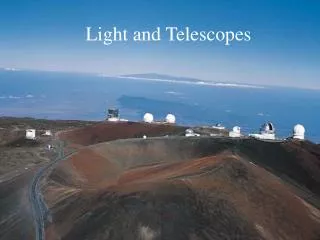
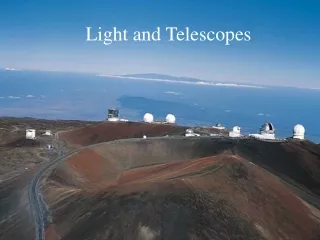
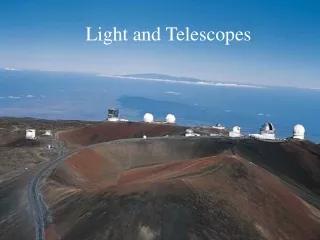
Very Large Telescopes Mauna Kea ESO – VLT
Minnesota’s $5M (private) investment in a very large telescope (> $100M) Large Binocular Telescope (LBT) Mt. Graham Arizona Design Other partners -- University of Arizona, Germany, Italy, Ohio State University, University of Virginia, Notre Dame
Arecibo Very Large Array – VLA
Telescopes in Space -- other wavelengths – UV, X ray, gamma ray and far-IR