Lunar Atmospheric Composition Experiment (LACE): Insights from Apollo 17 Mission
130 likes | 251 Vues
The Lunar Atmospheric Composition Experiment (LACE), deployed during Apollo 17 in Taurus-Littrow Valley, was activated on December 27, 1972. LACE investigated the moon's exosphere, revealing that gas molecules travel in ballistic paths after collisions with the lunar surface. These gases originate from sources like solar wind, volcanic activity, and meteoroid impacts. LACE utilized a sophisticated ion source and mass analyzer to detect gas molecules, producing a detailed dataset for analysis. Key researchers included Dr. Dave Williams and Dr. Kent Hills.


Lunar Atmospheric Composition Experiment (LACE): Insights from Apollo 17 Mission
E N D
Presentation Transcript
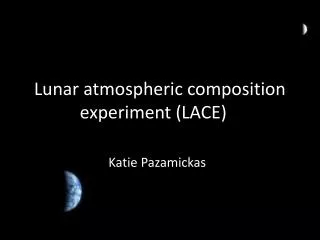
Lunar atmospheric composition experiment (LACE) Katie Pazamickas
LACE • Flew on Apollo 17 as a part of ALSEP. • Deployed in the Taurus-Littrow Valley (30° 45’ 53.6” E and 20° 11’ 31.6” N) • Turned on Dec. 27, 1972 at 18:07
The moon has an atmosphere? • Gas molecules travel in ballistic trajectories between collisions with the lunar surface classic exosphere. • Sources come from solar wind, lunar volcanism or meteoroid impacts. • No dipolar magnetic field, however once every lunar orbit the moon will pass through the Earth’s magnetotail for approximately 6 days.
How LACE Works • Gas molecules enter and are ionized by an electron bombardment ion source, collimated into a beam and sent through a magnetic analyzer to a detection system. • 3 mass ranges scanned simultaneously.
The Riddle • Each record consists of 90 x 16 array of numbers, or 1440 numbers, with only 1330 numbers of actual data. • 1330 steps, with a time between steps of .6 sec • 10 steps of background and 10 steps of internal calibration are inserted between sweeps • A sweep is 13.5 min
Thank You! • Dr. Dave Williams • Dr. Kent Hills • Dr. Ed Grayzeck • Dr. Mark Adrian • Cori Quirk